UGC Usage Rights: Perpetual Licensing, Raw Files, and What to Negotiate [2026]
UGC usage rights explained: perpetual vs time-limited licensing, raw file access, platform restrictions, exclusivity, and what to negotiate before signing a creator or agency contract.
Usage rights are the most expensive mistake in UGC — not because the rights themselves cost too much, but because the brands that skip this conversation pay for it later. A winning ad that expires. A video you cannot run on a second platform. Raw footage locked behind a creator who stopped responding.
Every one of these problems is preventable with a clear contract before production starts. This guide covers what to negotiate, what different terms cost, and how to structure rights so your creative library works for you long-term.
What Usage Rights Actually Mean
When a creator films a video, they own the copyright by default. The brand does not own the content until the creator grants a license — a legal permission to use it.
A usage rights agreement specifies three things:
- Where you can use the content — which platforms, which formats (organic, paid, email, website, OOH)
- How long you can use it — 3 months, 6 months, 12 months, or perpetual
- Exclusivity — whether the creator can sell or post similar content for competitors
Without a written agreement, the creator retains full copyright. They can ask you to stop running their content, negotiate a higher rate retroactively, or post the same video for a competitor. This is not theoretical — it happens regularly, especially with creators who work with multiple brands simultaneously.
Time-Limited vs Perpetual Rights
Most creator contracts default to time-limited rights. Here is what each term means in practice:
| Term | Duration | Typical Cost Premium | Best For |
|---|---|---|---|
| Short-term | 3 months | Base rate (no premium) | Seasonal campaigns, one-off tests |
| Standard | 6-12 months | +10-20% over base | Campaign-based work, product launches |
| Perpetual | Unlimited | +20-40% over base | Paid ad creative, evergreen content |
| Buyout | Unlimited + exclusive | +50-100% over base | High-spend campaigns, brand ambassador deals |
The case for perpetual rights on paid ads: The average winning UGC ad runs profitably for 30-90 days on Meta. But some winners run for 6 months or longer. If your rights expire at month 6, you face a choice: renegotiate (the creator knows they have leverage, so the price goes up) or lose the asset. At $500-$1,000 in renegotiation fees, the original 20-40% perpetual premium was the cheaper option.
When short-term rights are fine: Organic social content with a natural shelf life of 1-2 weeks. Seasonal campaigns that will not be reused. Test content where you are still validating whether UGC works for your product.
Raw Files: Why You Need Them
Raw files are the unedited footage — everything the creator filmed, without cuts, captions, music, or effects. Most creators and agencies deliver only the finished, edited video by default. The raw footage stays with whoever edited it.
Three reasons to negotiate raw file access:
1. Re-editing for new campaigns. Your best video from Q1 can become a new ad in Q3 with a different hook, updated CTA, or fresh captions. Without the raw footage, you need a new shoot. With it, a 30-minute editing session produces a new variation at near-zero cost. This is the foundation of ad variation strategies that scale creative output without scaling production costs.
2. Multi-market adaptation. A UGC video performing in the US market needs voiceover or subtitle changes for UK, EU, or MENA markets. Raw footage makes this possible. Finished videos with baked-in text overlays do not.
3. Format variations. A 60-second video works on Meta but needs a 15-second cut for YouTube Shorts and a 30-second version for TikTok. Raw footage gives your editor full control over pacing and composition for each platform.
Clean Versions Without Text
A related request that brands often forget: ask for a “clean” version of every finished video — the fully edited video without text overlays, captions, or CTAs burned in.
Clean versions let you:
- Add localized text overlays for different markets
- Test different headline/CTA copy on the same visual
- Reuse the visual in contexts where text is not needed (website background, email hero)
Include “clean version delivery” as a line item in the contract. It takes the editor 5 minutes to export and saves you a reshoot when you need the footage without text.
Platform and Format Rights
Usage rights should specify not just time, but scope — where the content can appear and in what context.
| Right | What It Covers | Watch For |
|---|---|---|
| Organic social | Posting on brand accounts without ad spend | Some contracts limit to specific platforms |
| Paid social (Meta, TikTok) | Running as a paid advertisement | Most expensive component — always negotiate this |
| YouTube / Google Ads | Pre-roll, in-stream, Discovery ads | Often excluded from “social media” rights |
| Website and email | Product pages, landing pages, newsletters | Usually included but confirm in writing |
| Whitelisting / Spark Ads | Running ads from the creator’s account | Requires separate creator account access |
| Out-of-home / print | Billboards, in-store displays, packaging | Almost always a separate negotiation |
The most common mistake: Negotiating “social media rights” and assuming that includes paid ads. Many creator contracts define “social media” as organic posting only. Paid advertising rights are a separate grant — always confirm in writing.
Cross-platform recommendation: Negotiate all-platform, paid-and-organic rights from the start. The cost premium is typically 10-20% over single-platform rights, which is trivially small compared to the cost of renegotiating after you discover your best TikTok ad cannot legally run on Meta.
Exclusivity: When It Matters
Exclusivity prevents the creator from working with competing brands for a defined period. It is expensive and usually unnecessary.
| Exclusivity Type | Duration | Typical Cost | When It’s Worth It |
|---|---|---|---|
| Non-exclusive | None | Included in base rate | 90% of campaigns — this is the default |
| Category exclusive | 3-6 months | +30-50% | The creator’s face is central to your campaign and you spend $20K+/month |
| Full exclusive | 6-12 months | +100-200% | Brand ambassador programs, long-term partnerships |
When exclusivity matters: If you are running a creator’s face as the primary visual in $50K+/month of ad spend, you do not want that face appearing in a competitor’s ads. The recognition value decays if the audience sees the same person promoting three different supplement brands.
When it does not matter: Most UGC campaigns use 5-15 creators per quarter. No single creator carries the campaign. At this volume, exclusivity is an unnecessary expense.
What OKAD Includes by Default
Different agencies handle rights differently. Here is how OKAD’s standard terms compare to what most agencies offer:
| Component | Typical Agency | OKAD |
|---|---|---|
| Usage rights duration | 6-12 months, renewal negotiable | Perpetual — no expiration |
| Platforms | Specified in contract (often limited) | All platforms, paid and organic |
| Raw files | Available for additional fee ($50-200) | Included on request |
| Clean versions (no text) | Not standard | Included on request |
| Exclusivity | Negotiated per creator | Non-exclusive by default (exclusive available) |
| Whitelisting access | Billed separately ($100-300/mo) | Included in retainer tiers |
| Multi-market adaptation rights | Separate license | Included in perpetual grant |
The pricing philosophy is simple: if you paid for the content, you should be able to use it wherever and whenever it works. Usage restrictions that force you to renegotiate or reshoot winning creative are a hidden cost that OKAD eliminates by default.
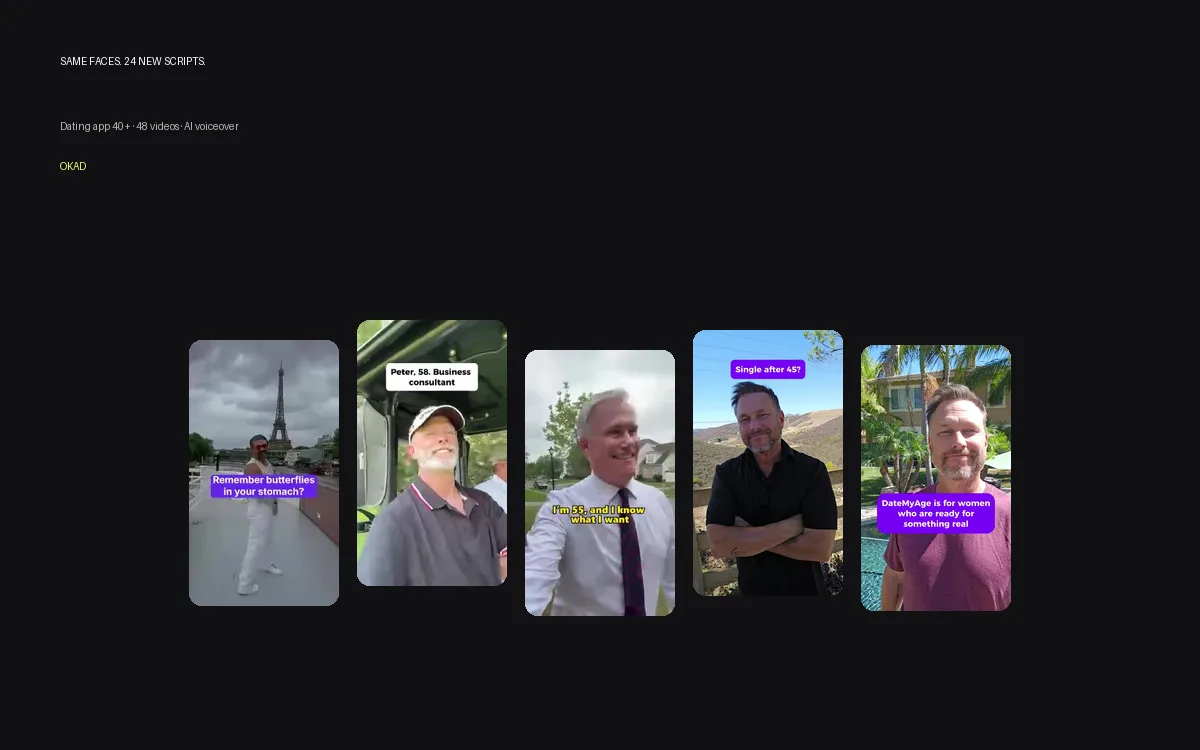
DateMyAge runs these creator videos across 6 markets. Perpetual rights and raw footage access made multi-market adaptation possible without a single reshoot. See the full case study.
The Negotiation Checklist
Before signing any creator or agency contract, confirm these items in writing:
Rights scope:
- Perpetual or time-limited? If time-limited, what is the renewal cost?
- All platforms or specific platforms listed?
- Paid advertising rights explicitly granted (not just “social media”)?
- Website, email, and landing page usage included?
Deliverables:
- Raw footage included or available for a fee?
- Clean versions (no text overlays) included?
- All format variations (9:16, 1:1, 4:5) included?
Exclusivity:
- Non-exclusive or category exclusive?
- If exclusive, for how long and at what cost?
Modifications:
- Can you re-edit the footage for new campaigns?
- Can you add new voiceover, subtitles, or text overlays?
- Can you use the footage in compilations or mashups with other creators?
Getting these answers before production starts costs nothing. Getting them after a winning ad expires costs everything.
For a detailed breakdown of how UGC creator rates factor in usage rights, and how whitelisting works as a rights extension, see those respective guides. If you are using AI tools in your creative pipeline, who owns AI-generated ads covers the copyright and IP questions specific to AI content. And for a full breakdown of what agencies charge and what should be included, see our UGC agency fee breakdown.
Work With OKAD
OKAD includes perpetual usage rights, all-platform licensing, and raw file access in every engagement. No renewal fees. No platform restrictions. No surprises.
See pricing and book a call · Or email olga@okad.agency with your monthly ad spend and goals.
Questions people ask
What are UGC usage rights?
Usage rights define where, how, and for how long a brand can use creator content. They specify which platforms (Meta, TikTok, YouTube, Google), which formats (organic, paid ads, email, website), and the time period (3 months, 12 months, perpetual). Without clear usage rights, a brand technically does not own the content — the creator does, and running it as a paid ad without permission is a copyright violation.
Should I always negotiate perpetual usage rights?
Yes, for paid ad content. Time-limited rights create a ticking clock on every winning ad. If a video performs well at month 5 and your rights expire at month 6, you either renegotiate (at a higher rate) or lose the asset. Perpetual rights cost 20-40% more upfront but eliminate renewal fees and prevent the loss of proven creative. For organic-only content with a short shelf life, shorter terms can be acceptable.
What are raw files and why do I need them?
Raw files are the unedited footage straight from the camera — no cuts, no captions, no music. You need them for three reasons: re-editing content for new campaigns without reshooting, adapting videos for different markets or languages, and creating variations (new hooks, different CTAs) from the same footage. Without raw files, every new version requires a new shoot.
Do UGC usage rights include all social media platforms?
Not automatically. Some creator contracts limit usage to specific platforms — for example, TikTok only, or organic posts only without paid ad rights. Always negotiate all-platform, paid-and-organic rights. The cost difference is usually 10-20% more than single-platform rights, but it prevents situations where your best-performing TikTok ad cannot legally run on Meta or YouTube.