60+ Ad Variations Without Filming: A Playbook
Four proven methods to multiply ad creative from existing footage. Real cases: 30 ads/day from hook swaps, 48 videos from script overlays, 80 re-edits from old clips.
Every brand running paid ads for more than six months has a folder of unused creator footage. Raw clips that never made the final cut. Winning ads from campaigns that ended. B-roll that was shot “just in case.” That folder is not dead weight. It is the cheapest source of new creative you have.
We have produced hundreds of ad variations for brands without a single new shoot. The methods range from simple hook swaps (change the first 3 seconds, keep everything else) to full re-edits that turn old footage into completely new concepts. Each method has a different cost, speed, and volume ceiling.
This playbook breaks down four methods with real cases and real numbers. Use it to decide which approach fits your situation — or combine them for maximum output.
The Four Methods
| Method | What Changes | What Stays | Volume Potential | Best For |
|---|---|---|---|---|
| Hook swap | First 2-3 seconds | Body + CTA | 3x per video | High-spend accounts needing daily fresh creative |
| Script overlay | Voiceover or text | Visual footage | 2x per creator set | Brands with proven creator footage and tired messaging |
| Format remix | Structure and pacing | Raw clips | 3-5 formats per clip set | Brands with diverse footage but few finished ads |
| Full re-edit | Hook, structure, sound, pacing | Raw footage | 5-10x per source batch | Brands with large unused footage libraries |
Each method is a force multiplier. Used together, they turn a single production shoot into months of testable creative.
Method 1: Hook Swaps — Swiss Skincare (30 Ads/Day)
The hook — the first 2-3 seconds of a video ad — is the single biggest performance variable in paid social. Meta and TikTok algorithms decide whether to push an ad based primarily on early engagement signals: thumb-stop rate, hook rate, and 3-second view percentage. Change the hook, and the algorithm treats it as a functionally new ad.
The Case
A Swiss skincare brand had a library of UGC clips — hundreds of creator videos showing product application, texture shots, before-and-after sequences, and testimonials. They needed fresh ads every day to sustain their paid campaigns across Meta and TikTok.
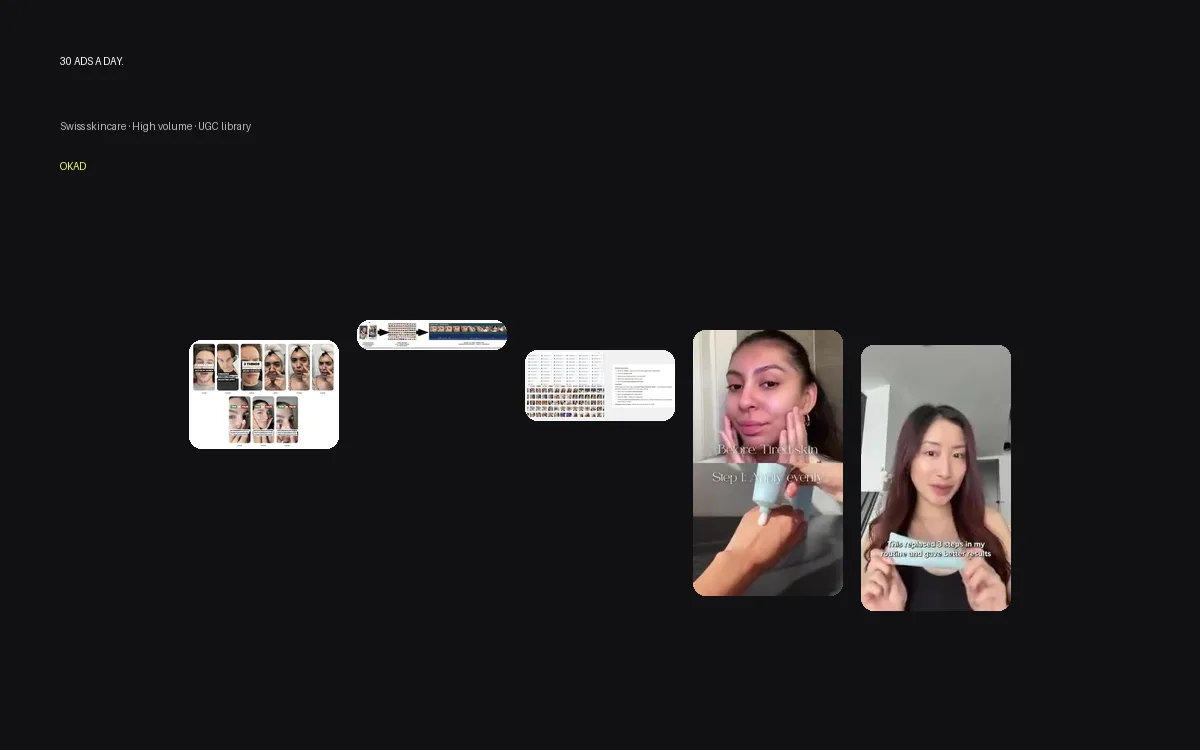
We built a hook swap system:
- ~10 new videos per day, each with 3 hook variations = roughly 30 ads per day
- 2-3 months of stable, continuous production
- Competitor research, scripts, and AI voiceover layered onto existing footage
- Weak hooks replaced without touching the proven body content
How the Hook Swap System Works
- Identify proven bodies. Review performance data. Any ad with strong hold rate (viewers watching past 50%) but mediocre CTR has a body that works and a hook that does not. That body is a candidate.
- Write 3-5 new hooks per body. Each hook tests a different angle: problem-aware (“Your moisturizer is not moisturizing”), curiosity (“Dermatologists are switching to this”), social proof (“200K orders and counting”), or urgency (“This sold out twice last month”).
- Edit the swap. Replace the first 2-3 seconds. Match the energy and pacing of the transition into the body. A jarring cut between hook and body kills performance.
- Launch and measure. Each hook variation gets its own ad set. Kill underperformers at 48 hours. Scale winners.
The Math
A single UGC video that costs $200-$400 to produce becomes 3-5 testable variations at roughly $15-$30 per hook swap (editing time only). If one in five hooks outperforms the original, the entire exercise pays for itself on the first winner.
At Swiss Skincare’s pace of 30 ads per day, the hook swap system produced roughly 900 testable ad variations per month — from a library that was originally built for maybe 20-30 finished ads.
Method 2: Script Overlay — DateMyAge (24 Scripts, 48 Videos)
A script overlay keeps the visual footage and replaces the narrative layer — voiceover, on-screen text, or both. The viewer sees the same creator doing the same actions, but hears a different story, benefit, or angle.
The Case
DateMyAge, a dating app for mature singles, had data showing their best-performing ads all featured the same 22 creators. The footage was proven — audiences trusted these faces. But the scripts were exhausted after months of running.
Instead of recasting with new creators (resetting trust to zero), we wrote 24 new scripts and laid them over existing footage:
- 48 videos total — each script cut for DateMyAge and its sister app
- 22 creators reused from winning ads
- 7 scripts with AI voiceover for concepts where original audio did not fit
- Zero new shoots
When Script Overlay Works
Script overlay is most effective when:
- The creator footage is the asset. If the audience has learned to trust certain faces, replacing them resets that trust. Keep the faces, change the words.
- The message has fatigued, not the visual. High frequency + declining CTR but stable hold rate = the audience is watching but the hook/CTA no longer moves them.
- The footage contains neutral actions. Footage of creators talking to camera, using a product, or walking through a space can support almost any script. Footage of specific actions (“unboxing this product for the first time”) is harder to repurpose.
AI Voiceover: Where It Works and Where It Does Not
Seven of the 24 DateMyAge scripts used AI-generated voiceover instead of the original creator audio. Our findings:
| Format | AI Voiceover Performance |
|---|---|
| Informational / list-style (“3 reasons to try dating at 50”) | Comparable to human VO |
| Emotional storytelling (“My first date after my divorce”) | Noticeably worse — authenticity gap |
| Problem-solution (“Tired of swiping? Here is why this is different”) | Acceptable with strong text overlay support |
AI voiceover is a viable tool for scaling script overlays, but it has limits. For emotional and personal content, original or re-recorded human audio still outperforms.
Method 3: Format Remix — Breakout Aid (6 Creators, 5 Formats, 15 Ads)
A format remix takes the same raw footage and restructures it into entirely different ad formats. A talking-head testimonial becomes an ASMR texture video. A product demo becomes a before-and-after comparison. The footage is identical — the format is new.
The Case
Breakout Aid, a skincare brand, had UGC from 6 creators and footage from a store launch event. They had no system for turning this into a diverse ad set.
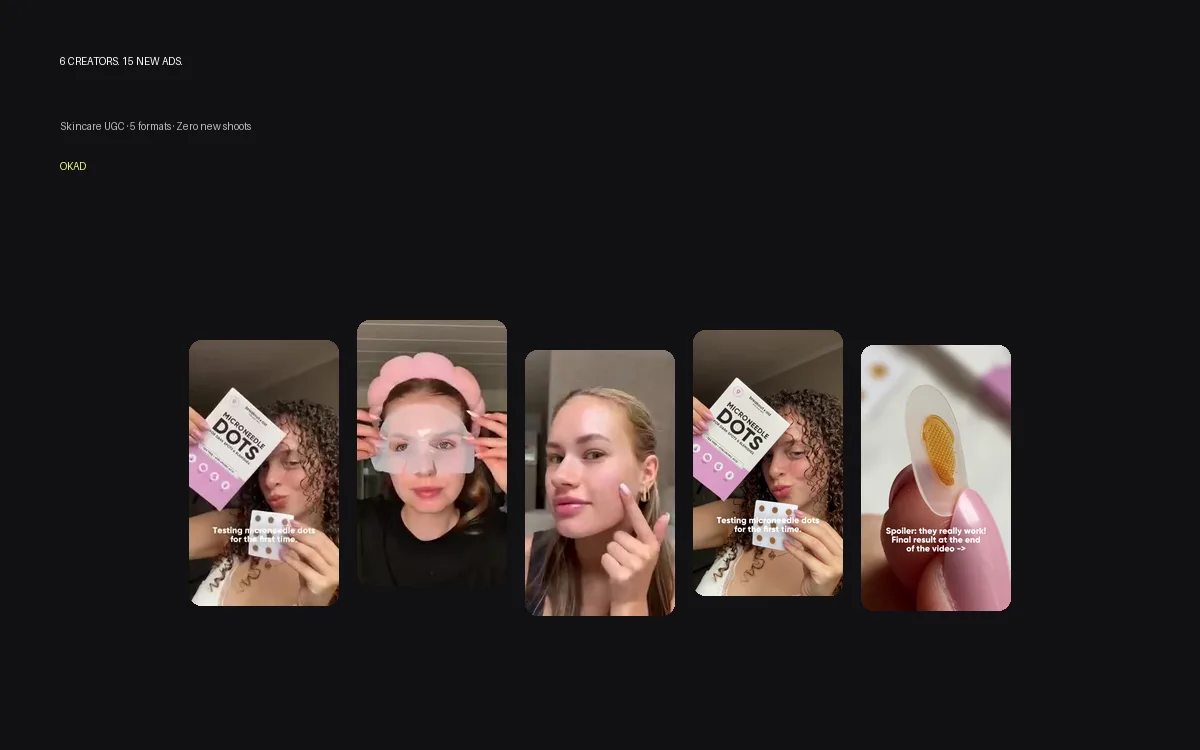
We sorted the footage into 5 formats and cut 15 ads:
- Sizzle reel — fast cuts of product textures, application, and results. No voiceover, just music and movement. Best for top-of-funnel awareness.
- Before/after — creator skin close-ups arranged into a transformation sequence. Highest conversion rate for skincare.
- ASMR — product application with amplified sound. Texture is the selling point for Breakout Aid, and ASMR showcases it directly.
- Store launch — event footage edited into a social proof narrative (“sold out on launch day”). Urgency and credibility in one format.
- How it is made — behind-the-scenes footage of ingredients and production. Builds trust for a category where ingredient transparency matters.
The Format Remix Framework
To remix footage into multiple formats, you need two things:
- A clip inventory. Log every usable clip by: creator, action shown (applying product, talking, close-up, full body), duration, audio quality, and visual quality. This inventory is the raw material for every remix.
- A format template library. Define 4-6 ad formats for your category, each with a specific structure (hook type, body flow, CTA style). Every new batch of footage gets cut against every template.
Breakout Aid’s 6 creators and store footage produced 15 ads across 5 formats. A brand with 10-15 creators and multiple product lines could produce 50-80 variations using the same method.
Method 4: Full Re-Edit — Five Brands (80 Ads) + ZenToes (60+ Variations)
A full re-edit goes beyond swapping hooks or overlaying scripts. It takes raw footage and rebuilds the ad from scratch — new hook, new structure, new sound design, new pacing. The source material is old, but the creative output is genuinely new.
Case A: Five Brands — 80 Fresh Ads From Old Footage
Every one of these five brands had been running ads for over a year. Each had a folder of creator videos that nobody opened anymore — early-stage content, failed concepts, unused b-roll, and retired winners.
We cut 80 new ads across all five brands:
- New hooks written for each brand’s current positioning and offers
- New structure — reorganizing footage into different narrative flows (problem-solution, listicle, testimonial, comparison)
- New sound — fresh music, sound effects, and in some cases AI voiceover
- Zero new shoots across all five brands
The key insight: footage does not expire. A creator applying a product six months ago looks identical to a creator applying a product today. What expires is the messaging wrapped around it.
Case B: ZenToes — 60+ Variations for a Walmart Launch
ZenToes was launching two foot creams at Walmart and needed ads fast. There was no time or budget for new production. But they had existing creator footage from previous campaigns.
We logged every existing clip the brand had — organized by creator, product shown, action type, and visual quality — and wrote ads around what was actually on camera:
- 11 videos cut from existing footage
- 14 static ads assembled from video stills and product shots
- 60+ testable variations when accounting for hook swaps and format remixes applied on top
- Zero new shoots
The Walmart launch required retail-specific messaging (“now available at Walmart,” shelf placement footage, price point callouts) that the original creator content was never designed for. Full re-editing made it possible — the creator footage provided authenticity and product demonstration, while new text overlays, voiceover, and structure delivered the retail message.
The Asset Audit Process
Full re-edits start with a systematic inventory of what you have. Here is the audit process we use:
- Export everything. Pull all footage from cloud storage, creator deliveries, and old campaign archives into one location.
- Log each clip. Spreadsheet columns: file name, creator, duration, product shown, action (applying, talking, unboxing, close-up), audio quality (usable/not), visual quality (A/B/C), and notes.
- Tag re-edit potential. Mark clips that show the product clearly, have clean visuals, and are at least 3 seconds long. These are your raw materials.
- Gap analysis. What is missing? If you have plenty of application footage but no close-ups, that limits certain formats. Identify gaps before you start writing.
- Write scripts to footage. This is the opposite of normal production. Instead of writing a script and then shooting it, you watch what exists and write ads that match what is on camera.
Combining Methods: The Multiplication Stack
These four methods are not mutually exclusive. Stack them for exponential output:
Starting point: 10 original UGC videos
| Layer | Method | Output |
|---|---|---|
| Layer 1 | Hook swaps (3 per video) | 30 variations |
| Layer 2 | Script overlays (2 per video) | 20 additional |
| Layer 3 | Format remixes (2 per video) | 20 additional |
| Layer 4 | Full re-edits (1 per 5 videos) | 2 new concepts |
| Total | 72 testable variations |
From 10 source videos, you produce 72 variations at roughly 15-20% of the cost of producing 72 original ads. Not every variation will perform. But at this volume, you only need a 10-15% win rate to dramatically outpace a brand testing 5-10 new ads per month.
When Each Method Fits
Choosing the right method depends on three factors: what footage you have, how fast you need output, and what has fatigued.
| Situation | Best Method | Why |
|---|---|---|
| High-spend account burning through creative weekly | Hook swaps | Fastest output, lowest cost, keeps proven bodies alive |
| Proven creators with exhausted messaging | Script overlay | Preserves audience trust in familiar faces |
| Diverse footage but few finished ads | Format remix | Extracts maximum value from every clip |
| Large unused footage library (6+ months old) | Full re-edit | Unlocks dormant assets with fresh concepts |
| Retail launch or new positioning needed fast | Full re-edit + hook swaps | Re-edits for new messaging, hook swaps for testing volume |
The Cost Comparison
The economics are straightforward. New production costs $200-$500 per finished ad (creator fees, scripting, editing). Each multiplication method costs a fraction of that:
| Method | Cost Per Variation | Speed | Requires |
|---|---|---|---|
| Hook swap | $15–$30 | Same day | Existing finished ads with performance data |
| Script overlay | $40–$80 | 1–2 days | Existing footage + new scripts or voiceover |
| Format remix | $50–$100 | 2–3 days | Raw footage inventory + format templates |
| Full re-edit | $80–$150 | 3–5 days | Complete asset audit + new creative direction |
| New production | $200–$500 | 1–3 weeks | Creator booking, scripting, shooting, editing |
A brand spending $3,000 on new production gets roughly 6-15 new ads. That same $3,000 spent on multiplication methods produces 30-100+ variations from existing footage. The quality per variation is lower on average, but the testing surface is 5-10x larger — and testing surface is what finds winners.
Building Your Multiplication Pipeline
If you are sitting on unused footage and want to start extracting value from it:
- Run the asset audit. Log every clip you have. You cannot multiply what you have not inventoried. Most brands are surprised by how much usable footage they already own.
- Start with hook swaps. They are the fastest, cheapest, and lowest-risk method. Take your top 5 performing ads, write 3 new hooks each, and launch 15 new variations this week.
- Identify your script overlay candidates. Any creator footage with high hold rate but declining CTR is a candidate. The footage still works — the message needs refreshing.
- Build format templates. Define 4-5 ad formats that work in your category (testimonial, ASMR, before/after, listicle, problem-solution). Apply each template to your best footage.
- Schedule quarterly full re-edits. Every 3 months, pull the unused footage from the past quarter and produce a batch of fully re-edited concepts. This keeps the library productive indefinitely.
The brands that scale their ad programs are not the ones spending the most on new production. They are the ones extracting the most value from every piece of footage they have ever produced. Your next 60 best-performing ad variations might already be sitting in a folder you stopped opening months ago.
Questions people ask
How many ad variations can you create without new footage?
It depends on the method and the size of your existing library. Hook swaps alone can triple your output — Swiss Skincare produced roughly 30 ads per day from a single UGC library. Script overlays doubled DateMyAge's output to 48 videos from 22 creators. With a combination of methods, brands routinely produce 60-100+ variations from footage they already own.
What is a hook swap in advertising?
A hook swap replaces the first 2-3 seconds of an ad while keeping the body and CTA intact. Since the hook is the single biggest performance variable in paid social ads, swapping it creates a functionally new ad for the algorithm without reshooting anything. Each hook swap tests a different angle, emotion, or promise against the same proven body content.
Is repurposed ad footage as effective as new creative?
Yes, when done correctly. The algorithm treats a re-edited video as new creative. Performance depends on the hook and the first 3 seconds, not whether the footage was shot yesterday or six months ago. DateMyAge's script refreshes over existing creators performed comparably to their original ads because the faces were already trusted by the audience.
What is the cheapest way to get more ad variations?
Hook swaps are the cheapest method — they require only 2-3 seconds of new editing per variation. Script overlays (new voiceover or text over existing footage) are next. Full re-edits cost more but produce the most differentiated output. All three methods cost a fraction of new production: typically 10-20% of the original shoot cost.
How do I know if my existing footage is good enough to repurpose?
Start with an asset audit. Log every clip by creator, duration, action shown, and audio quality. Footage is repurposable if it has clean visuals (decent lighting, stable framing), the product is visible, and the clips are at least 3-5 seconds each. You do not need perfect footage — you need enough variety to combine into new sequences.