Alcohol Brand Advertising: 900K Views + Compliance
How a premium alcohol brand achieved 200K-900K organic views per post while maintaining full TTB compliance. Production, creator sourcing, and editing secrets.
Alcohol brand advertising is one of the most technically demanding categories in content marketing. The creative must be visually premium. The talent must have real bartending expertise. The pacing must be slower than standard social media. And every piece of content must comply with TTB regulations, platform-specific age restrictions, and responsible drinking guidelines — across Meta, TikTok, and YouTube simultaneously.
Most agencies treat alcohol content like any other product category. They use fast-cut editing, source generic lifestyle creators, and check compliance as an afterthought. The result is content that either looks amateur (wrong glassware, sloppy pours, incorrect technique) or gets flagged and removed for compliance violations.
Godka, a premium alcohol brand, took a different approach. The result: 200K to 900K organic views per post, full TTB compliance across all platforms, and a production system that turns single shoot days into weeks of content. Here is how it works.
Why Most Agencies Fail at Alcohol Content
Before diving into what works, it is worth understanding why alcohol advertising is uniquely difficult. The failure modes are specific and predictable.
Failure Mode 1: No Bartending Expertise
This is the most common and most damaging mistake. When a general creative agency produces alcohol content, they hire a model or influencer to hold a bottle and pour a drink. The result looks wrong to anyone who knows cocktails — and the target audience for premium alcohol brands absolutely knows cocktails.
Specific tells:
- Wrong pour technique. Not using a jigger for measurement, or using it incorrectly.
- Sloppy straining. The Hawthorne strainer requires a specific grip and angle. Amateurs hold it wrong.
- Incorrect glassware. Serving a Negroni in a martini glass, or a Manhattan in a tumbler.
- Missing details. No expressed oils from a citrus peel, no proper ice program, no attention to garnish placement.
These details matter because premium alcohol consumers are enthusiasts. They notice every mistake, and it undermines the brand’s credibility.
Failure Mode 2: Wrong Pacing
Standard social media editing uses 1-2 second cuts. This is effective for fast-moving consumer products, fashion, and tech — but it is wrong for premium alcohol.
Alcohol content needs to breathe. A proper pour takes time. Ice cracking in a glass is a 3-second moment. The condensation forming on a copper mug is a visual that rewards patience. When you cut these moments short, you strip away the sensory quality that makes alcohol content compelling.
The Godka approach uses 3-5 second shots — roughly 2-3x longer than typical social media pacing. This feels slow by Instagram standards, but it is what drives the aspirational quality that generates saves and shares.
Failure Mode 3: Compliance Gaps
Alcohol advertising is regulated at federal (TTB), state, and platform levels. The requirements:
- Age verification. All paid campaigns must target 21+ audiences in the US (25+ in some markets).
- No targeting minors. Content cannot feature elements that appeal primarily to underage audiences (cartoons, school settings, youth culture references).
- Responsible drinking messaging. Required in many markets and recommended in all.
- Platform-specific rules. Meta requires age-gated audiences. TikTok bans alcohol advertising entirely in most markets. YouTube requires age verification for organic alcohol content.
Agencies that do not specialize in alcohol often learn these rules through violations — content gets removed, accounts get flagged, and campaigns lose momentum.
The Godka Approach: Three Keys to 900K Views
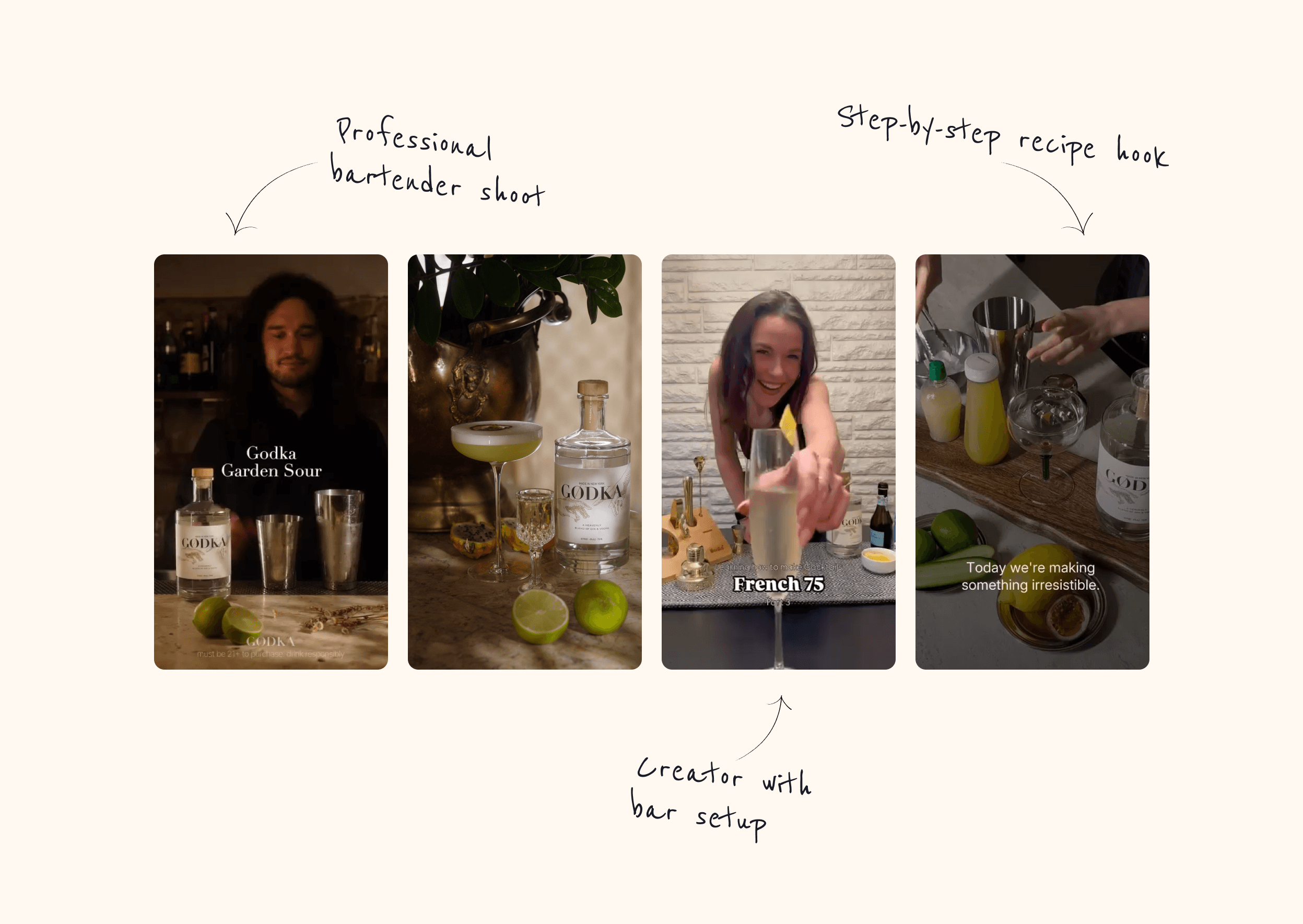
Godka’s organic content consistently achieves 200K-900K views per post. This is not paid reach — it is organic performance driven by content quality and strategic production. Three elements make it work.
Key 1: Professional Bartending on Set
Every Godka production features a professional bartender — not an actor who learned to pour for the shoot, but someone with years of bar experience who brings authentic technique to every frame.
Why this matters:
- Technique is content. A skilled bartender making a cocktail is inherently watchable. The jigger measurement, the confident pour, the clean strain, the precise garnish — each step is a visual moment.
- Speed and consistency. A professional bartender can execute 15-20 cocktail setups in a single production day. An amateur needs multiple takes for each one, cutting output by 3-4x.
- Creative input. Professional bartenders suggest cocktail variations, presentation ideas, and techniques that the creative team would not think of. They are creative collaborators, not props.
The production setup in Lisbon includes a full bar setup with professional lighting, multiple camera angles, and a library of glassware, garnishes, and tools. Each production day generates content for 2-4 weeks of posting.
Key 2: Slow-Paced Editing
The editing philosophy for Godka is deliberately counter to social media trends:
| Element | Standard Social | Godka Approach |
|---|---|---|
| Shot duration | 1-2 seconds | 3-5 seconds |
| Cuts per minute | 30-40 | 12-20 |
| Music tempo | Fast/trending | Ambient/lounge |
| Text overlays | Heavy | Minimal |
| Transitions | Jump cuts | Smooth/dissolves |
This pacing achieves two things:
- It signals premium quality. Fast cuts feel like advertising. Slow pacing feels like cinematography. The audience reads slow pacing as confidence — the brand does not need to rush because the product speaks for itself.
- It earns saves and shares. Aspirational content gets saved. Informational content gets liked. Saved content is weighted more heavily by Instagram’s algorithm, which drives the 200K-900K organic reach numbers.
Key 3: Vetted Creator Network
Alcohol UGC is a rare niche. Most UGC creators are not suitable for alcohol content because:
- They are not of verified legal drinking age
- They have no bartending knowledge
- They are uncomfortable with alcohol compliance restrictions
- Their existing content style does not match premium pacing
We maintain a network of creators who are specifically vetted for alcohol content. The vetting process includes age verification, portfolio review for relevant experience, compliance training, and a test shoot to evaluate technique and on-camera presence.
For Godka, we combined this creator network with our professional bartender to produce two content streams:
- Hero content — Professional production with the bartender, full lighting setup, and cinematic editing. This is the 900K-view content.
- UGC-style content — Creator-produced content that feels more casual and authentic while maintaining technical accuracy and compliance. This extends reach to audiences who engage more with relatable content than aspirational content.
TTB Compliance: The Non-Negotiable Framework
Every piece of Godka content passes through a compliance review before publishing. Here is the framework.
Pre-Production Compliance
Before any shoot:
- Confirm all talent is of legal drinking age (documented)
- Review shot list for compliance risks (no minors in frame, no excessive consumption, no driving/operating machinery)
- Prepare responsible drinking messaging for applicable markets
- Review platform-specific restrictions for the intended distribution channels
Production Compliance
During the shoot:
- No shots implying excessive consumption
- Proper glassware and serving sizes (no oversized pours)
- Professional environment (not targeting youth settings)
- Clean technique (reinforces responsible consumption)
Post-Production Compliance
Before publishing:
- Age gate verification on all paid distribution
- Platform-specific audience targeting (21+ US, 25+ in stricter markets)
- Responsible drinking messaging included where required
- Review against TTB mandatory statements for the specific product category
Platform-Specific Rules
| Platform | Alcohol Advertising Status | Key Requirement |
|---|---|---|
| Meta (Instagram/Facebook) | Allowed with restrictions | Age-gated audiences, no appeal to minors |
| TikTok | Banned in most markets | Organic only in permitted markets, strict content guidelines |
| YouTube | Allowed with restrictions | Age verification on organic content, age-gated paid |
The TikTok restriction is significant. Many alcohol brands invest heavily in TikTok content only to have it removed. The strategy for TikTok must be organic-only and carefully compliant with local market rules.
AI as Production Multiplier
One production day with a professional bartender generates 15-20 cocktail setups. That is substantial but finite. AI extends this output.
We use AI-generated visuals for:
- Cocktail concept art — Visualizing seasonal recipes and limited editions before committing to production.
- Ingredient beauty shots — Close-up visuals of botanicals, fruits, spices, and other cocktail components.
- Environment extensions — Background and setting visuals that complement live-action footage.
- Social media supplements — Story content, carousel graphics, and promotional visuals that fill the content calendar between production days.
AI does not replace live-action production. The hero content — the 900K-view posts — is always shot with real talent, real products, and real cocktails. But AI fills the gaps, turning one production day per month into 20-30 pieces of content instead of 8-10.
The Results in Context
Godka’s numbers:
- 200K-900K organic views per post — no paid amplification on top-performing content
- Full TTB compliance — zero content removals or platform violations
- Efficient production — single production days generating weeks of content
- Creator network — vetted talent for consistent quality across UGC and hero content
These results are driven by the intersection of three specializations: bartending expertise, premium content production, and regulatory compliance. Remove any one of these, and the system breaks down.
What Premium Alcohol Brands Should Look For
If you are evaluating agencies or production partners for alcohol content, here is what to assess:
1. Ask About Bartending
Does the agency have access to professional bartenders? Can they explain the difference between stirred and shaken technique? Do they know which glass is correct for which drink? If the answer is vague, the content will look amateur.
2. Review Pacing
Watch the agency’s alcohol portfolio at normal speed. If every video uses fast cuts and trending audio, they are applying a generic social media template to a category that requires a different approach. Look for slow, confident pacing.
3. Verify Compliance Knowledge
Ask specifically about TTB requirements, platform-specific rules, and age verification processes. An agency that specializes in alcohol should be able to discuss these without hesitation. If compliance is described as “we check it at the end,” that is a red flag.
4. Evaluate Creator Sourcing
How does the agency source and vet creators for alcohol content? Alcohol UGC requires specific qualifications — age verification, product knowledge, compliance training. A general UGC creator roster is not sufficient.
5. Examine Production Efficiency
A professional alcohol content production should generate 15-20+ setups per day. If the agency quotes 4-5 pieces of content per production day, their process is not optimized for alcohol-specific workflow.
The Bottom Line
Alcohol brand advertising is a specialist category. The brands that achieve viral organic reach — the 200K-900K views per post — combine real bartending expertise, premium slow-paced production, strict compliance frameworks, and AI-extended content calendars. The brands that struggle treat alcohol like any other product and wonder why the content underperforms or gets removed.
The difference is specialization. General agencies produce general results. Alcohol-specific production, with vetted creators and compliance built into the process from day one, produces 900K-view posts that never get flagged.
Questions people ask
What are the TTB compliance rules for alcohol advertising?
TTB (Alcohol and Tobacco Tax and Trade Bureau) regulations require age verification gates, prohibition of targeting minors, mandatory responsible drinking messaging, and restrictions on health claims. Each platform has additional rules: Meta requires age-gated audiences (21+ in the US), TikTok prohibits alcohol ads entirely in some markets, and YouTube requires age verification for alcohol content. Violations can result in content removal, account suspension, or legal action.
Why do most agencies fail at alcohol brand content?
Three reasons: they lack bartending expertise (resulting in visually incorrect pours, wrong glassware, and amateur technique), they use standard 1-2 second fast-cut editing (which does not suit premium alcohol's slow-paced brand feel), and they overlook platform-specific compliance requirements. Alcohol content requires specialized knowledge that general creative agencies do not have.
How do you source creators for alcohol UGC?
Alcohol UGC is a rare niche because creators must be of legal drinking age (verified), comfortable on camera with alcohol products, knowledgeable about proper drink preparation, and willing to work within strict compliance frameworks. We maintain a vetted network of creators who meet all criteria. For the Godka campaign, we used a professional bartender on set to ensure every pour, technique, and presentation was authentic.
What is the ideal video pacing for alcohol brand content?
Premium alcohol content performs best with 3-5 second shots, compared to the typical 1-2 second cuts used in most social media content. Slow pacing communicates quality, craftsmanship, and sophistication. It gives viewers time to appreciate the visual details — the pour, the garnish, the condensation on the glass. Fast cuts feel promotional; slow pacing feels aspirational.
Can AI help with alcohol brand content production?
Yes, strategically. We used AI-generated cocktail visuals to extend shoot output — turning a single production day into weeks of content. AI handles supplemental visuals (ingredient beauty shots, cocktail concept art, background environments) while live-action footage handles the core brand content. This multiplies production value without multiplying production days.