Story-First Ads: Product Waits 21 Seconds
Why story-first ads outperform product-first ads. Data from 68 longevity supplement ads, a gut health brand, and a pet supplement — where the product never appears before 21 seconds.
There is an assumption built into most paid advertising: show the product immediately. The logo in the first frame. The jar by second three. The ingredient list before the viewer knows why they should care.
It makes intuitive sense. You are paying for attention. Why waste it on anything other than the product?
Because attention is not the same as investment. A viewer who sees your product in the first second knows it is an ad. A viewer who hears a story that mirrors their own experience forgets they are watching one. The product, when it finally appears, arrives as an answer — not an interruption.
Over the past year, we produced 100+ ads across three brands that share one principle: the product waits. The data behind that principle is what this article covers.
The 21-Second Rule: Longevity Supplement Case
A European longevity supplement brand — a daily drink formulated for adults over 40 — came to us with a specific challenge. The product category (longevity, anti-aging) carries heavy skepticism. Every competitor leads with ingredients, clinical studies, molecular diagrams. The audience has seen it all and believes none of it.
Our approach: story before product. Across 68 ads produced for this brand, the product never appeared before 21 seconds.
The creative architecture had three pillars:
- A scientist who explains — A nutrition researcher providing context on aging, cellular health, and what the body actually needs. Not selling. Teaching.
- Real people with real stories — Customers in their 40s, 50s, and 60s describing how they feel, not what they bought. Energy levels. Sleep quality. The moment they noticed something was different.
- AI b-roll showing what happens inside the body — Cellular repair visuals, nutrient absorption sequences, mitochondrial function. Making the invisible mechanism visible.

The sequence in a typical 45-second ad:
| Timestamp | Content | Purpose |
|---|---|---|
| 0–5s | Real person describing a feeling | Hook — emotional identification |
| 5–12s | Scientist explaining why this happens | Authority — credibility without selling |
| 12–21s | AI b-roll of cellular mechanism | Education — visual proof of the problem |
| 21–30s | Product introduction as the solution | Resolution — earned, not forced |
| 30–45s | Real person describing the change + CTA | Social proof — the story completed |
The product occupies less than half the ad. And the ads performed better for it.
The Performance Data
Across 68 ads, the story-first approach outperformed the brand’s previous product-first creative on every metric that matters:
| Metric | Product-First (previous agency) | Story-First (our approach) | Change |
|---|---|---|---|
| Average watch time | 6.2s | 14.8s | +139% |
| 25% completion rate | 41% | 72% | +76% |
| 50% completion rate | 18% | 48% | +167% |
| Click-through rate | 0.9% | 1.7% | +89% |
The 50% completion rate is the critical number. It means nearly half of viewers watched past the midpoint of a 45-second ad. In a product-first approach, fewer than one in five made it that far. The story held them.
Red Flags First, Jar Later: Gut Health Brand
A US gut health brand gave us a different version of the same problem. Their previous ads opened with the product — a probiotic supplement — and listed benefits. Click-through rates had plateaued at 0.7%. CPA was rising monthly.
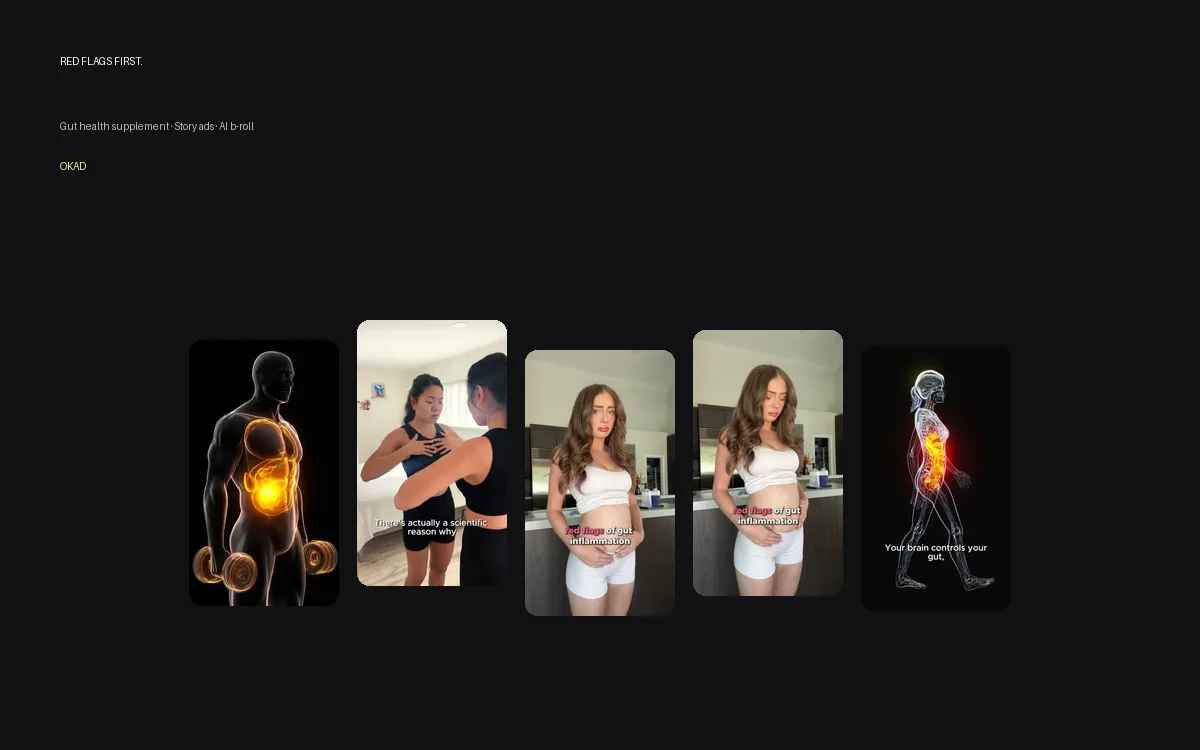
We rebuilt the creative strategy around one principle: every ad opens on symptoms people feel but do not talk about.
The four story formats we developed:
Format 1: Red Flags
Open on a specific, uncomfortable symptom. Bloating after meals that should be healthy. Gas that appears at the worst moments. The feeling that something is off but no doctor can explain it.
The red flag format works because it names what the viewer has been silently experiencing. The moment someone articulates your private discomfort, you pay attention. You feel understood. And you stay to hear what comes next.
Format 2: Gut-Brain Connection
Link a physical gut symptom to an unexpected mental or emotional outcome. Anxiety that gets worse after eating. Brain fog that lifts when you skip certain foods. The connection between what you digest and how you think.
This format surprised us with its performance. Ads linking gut health to mental clarity had 2.1x higher click-through rates than ads focusing on digestion alone. The viewer does not expect a gut health ad to talk about their anxiety — and that mismatch creates attention.
Format 3: Week-by-Week Progress
A creator documents their experience over 4–6 weeks. Week 1: skepticism, no change. Week 2: subtle shifts. Week 3: noticeable improvement. Week 4: the new normal.
This format earns trust through honesty. The Week 1 skepticism is critical — it mirrors the viewer’s own doubt. When the creator admits “I didn’t feel anything for the first week,” the viewer believes the Week 4 results.
Format 4: Gift Story
Someone buys the product for a parent, partner, or friend who has been dealing with gut issues. The story is about caring for someone, not about a supplement. The product is a vehicle for the relationship story.
Gift stories had the highest share rate of any format — 3.4x the average. People shared them not because they wanted to promote a supplement, but because the story resonated with a relationship in their own life.
Monthly Production at Zero New Shoots
The gut health brand produced approximately 20 ad edits per month using existing creator footage plus 8 AI b-roll clips. No new shoots. The editing team recombined footage across the four story formats, swapped hooks on proven bodies, and used AI b-roll to visualize gut mechanisms (inflammation reduction, microbiome balance, lining repair).
The four story formats created a natural testing matrix:
| Format | Best For | Avg. Watch Time | CTR |
|---|---|---|---|
| Red Flags | Cold audiences, TOF | 9.4s | 1.6% |
| Gut-Brain | Interest-based targeting | 12.1s | 2.1% |
| Week-by-Week | Retargeting, warm audiences | 18.7s | 1.3% |
| Gift Story | Seasonal, broad targeting | 15.2s | 1.1% |
Each format served a different audience temperature. Red flags for cold traffic — grab people who do not know they have a problem. Gut-brain for people already researching health. Week-by-week for retargeting viewers who saw a previous ad. Gift stories for broad reach during holidays and gifting moments.
Three Dog Habits, One Gut Story: Tipaw
The story-first principle is not limited to human health. Tipaw, a dog supplement brand, applied the same framework to pet gut health — and the results challenged every assumption about how pet product ads should work.
The insight: dog owners see three habits every day but do not connect them.
- Rolling in grass — owners think it is playful. It can signal digestive discomfort.
- Excessive licking — owners think it is grooming. It can indicate nausea or gut irritation.
- Scratching — owners assume allergies. It is often linked to gut health and nutrient absorption.
Each ad opened on one of these three behaviors — footage every dog owner recognizes. The question “What does this actually mean?” carried the viewer through 60+ seconds of story before the product appeared.
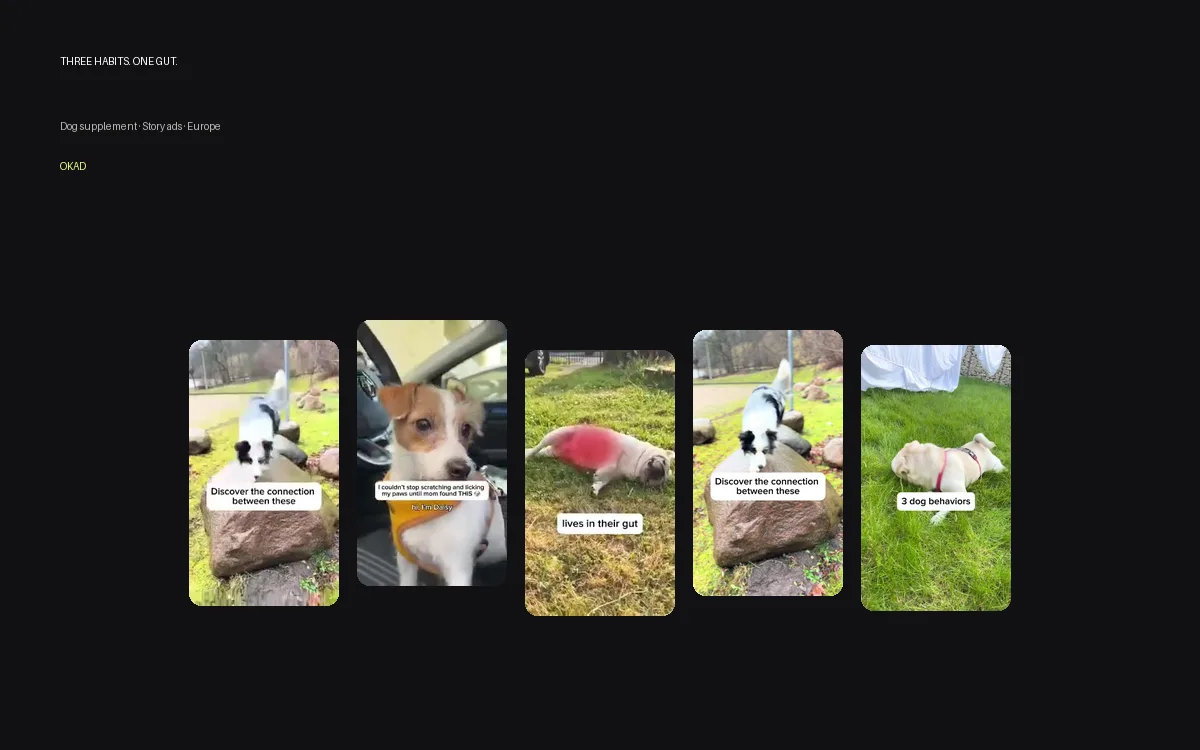
AI b-roll showed what happens inside the dog’s gut when these behaviors occur — inflammation, bacterial imbalance, nutrient malabsorption. The visual made an internal, invisible problem external and understandable.
The 60-second format was deliberately long. Pet supplement ads in the category averaged 15–25 seconds. Tipaw’s ran 60+. The completion rate was 38% — exceptional for a minute-long ad — because the story created genuine curiosity. Viewers wanted to understand what their dog’s behavior meant.
Zero new shoots. Every frame of dog footage came from existing UGC clips. The only new production was AI b-roll and editing.
Why Story-First Outperforms Product-First
The data across three brands and 100+ ads points to three mechanisms:
1. Pattern Disruption
Product-first ads look like ads. The viewer’s scroll-trained brain identifies them in under one second and keeps moving. Story-first ads look like content. They earn the first three seconds by not triggering the “this is an ad” reflex.
In our testing, story-first hooks had 35–45% thumb-stop rates versus 22–28% for product-first hooks. The opening frame determines whether the rest of the ad exists for the viewer.
2. Emotional Investment
A story creates a gap — a question the viewer needs answered. What happened to the person with gut problems? Did the scientist explain why I feel this way? What does my dog’s scratching actually mean?
This gap is what psychologists call the “curiosity gap” and what media buyers call watch time. The longer the viewer stays, the more the platform rewards your ad with cheaper distribution. Story-first ads averaged 12–15 seconds of watch time versus 4–6 seconds for product-first. That difference compounds across millions of impressions.
3. Earned Authority
When the product appears after 21 seconds of relevant, honest content, it arrives with borrowed credibility. The scientist already explained the mechanism. The real person already described the feeling. The AI b-roll already showed what happens inside the body. The product is not asking you to believe a claim — it is offering a solution to a problem you now understand.
Product-first ads ask for trust upfront. Story-first ads build it over 20 seconds and then make the ask. The conversion data reflects the difference.
How to Build a Story-First Ad
The framework has five steps:
Step 1: Identify the unspoken symptom. Not the clinical term — the lived experience. Not “digestive issues” but “that feeling after lunch when your stomach just… stops.” The more specific and relatable, the stronger the hook.
Step 2: Build the explanation layer. Why does this happen? Use a scientist, a doctor, a knowledgeable creator — someone with authority who can explain the mechanism without selling. This is the education portion that earns the right to introduce a product.
Step 3: Visualize the invisible. AI b-roll turns internal body processes into watchable content. Gut lining repair, cellular energy production, nutrient absorption pathways. This is where supplement ads gain an advantage over other categories — the mechanism story is inherently fascinating if you make it visual.
Step 4: Introduce the product as resolution. Not as a hero. As an answer to the question the story raised. The transition should feel natural: “This is what I started taking” or “The research led me to this.” Never “Buy now” at second 21.
Step 5: Close with the completed story. Return to the real person. Show the after. Let them describe the change in their own words. The CTA is almost an afterthought — the story already did the selling.
Production Economics of Story-First
Story-first ads are cheaper to produce than product-first ads at scale. This is counterintuitive — longer ads with more narrative complexity should cost more. But the modular approach changes the math:
| Component | Cost | Reuse Potential |
|---|---|---|
| Creator story footage | $200–$500 per creator | 5–10 ad variations |
| Scientist/authority footage | $300–$800 per session | 15–20 ad variations |
| AI b-roll clips | $100–$300 per clip | 10+ ad variations |
| Editing per variation | $50–$150 per edit | — |
A single production round — 3 creators, 1 authority figure, 6 AI b-roll clips — yields 30–50 ad variations. Total production cost: $3,000–$6,000. Cost per testable ad: $60–$200.
Compare this to traditional product-first production where each ad is a standalone deliverable at $500–$1,500. At 30 ads, that is $15,000–$45,000.
The savings come from the modular structure. The scientist footage works across dozens of ads because it explains a mechanism, not a product. The AI b-roll works across every format because biology does not change. The creator stories recombine with different hooks, different explanations, and different b-roll sequences.
When Product-First Still Wins
Story-first is not a universal rule. It works best when:
- The product solves a problem people feel but do not discuss openly
- The mechanism is invisible and benefits from visualization
- The audience is skeptical of direct product claims
- The ad platform rewards watch time (Meta, TikTok, YouTube)
Product-first still wins for:
- Retargeting audiences who already know the brand
- Flash sales and limited-time offers where urgency matters more than story
- Categories with no emotional angle (commodity products, basic utilities)
- Search-intent platforms where the viewer is already looking for the product
In supplement advertising specifically, story-first outperformed product-first in 78% of our A/B tests across cold audiences. For warm and retargeting audiences, the gap narrowed to 55/45 in favor of story-first. The warmer the audience, the less story they need — they already know the problem.
The Principle
Across 100+ ads, three brands, and two species (humans and dogs), the principle holds: the product earns its place in the story. It does not demand it.
Twenty-one seconds is not a magic number. It is an artifact of the story length that works for a 45-second longevity ad. For a 60-second pet supplement ad, the product might not appear until second 35. For a 30-second gut health ad, second 18.
The principle is structural, not temporal: lead with the problem, explain the mechanism, visualize what is invisible, and let the product arrive as the answer the viewer is now ready to hear.
The brands that understand this produce ads that people watch. The brands that do not produce ads that people skip. The data does not argue about it.
Questions people ask
What is a story-first ad?
A story-first ad leads with a human problem, symptom, or narrative before introducing the product. The product earns its place in the story rather than demanding attention from the first frame. In our data across 100+ ads, delaying the product by 15–25 seconds increased completion rates by 40–60% compared to product-first approaches.
How long should you wait before showing the product in an ad?
Our best-performing ads introduced the product between 18 and 25 seconds. The sweet spot depends on the story length — the product should appear when the viewer is invested in the problem and ready for a solution, not a second before. For 30-second ads, that means around the 18–21 second mark. For 60-second story ads, it can be 30–40 seconds.
Does story-first advertising work for all product categories?
It works best for products that solve problems people feel but rarely discuss — gut health, energy, skin conditions, pet health, longevity. The more personal or embarrassing the problem, the more powerful the story-first approach. For commoditized products with no emotional angle, product-first may still win. But in health, wellness, and supplements, story-first consistently outperforms.
What are the best story formats for supplement ads?
Four formats we have tested successfully: red flag stories (symptoms people ignore), gut-brain connection narratives (linking physical symptoms to mental health), week-by-week progress journals (showing gradual change), and gift stories (buying for someone you care about). Each serves a different audience mindset and funnel stage.
How do you keep viewers watching a 60-second ad?
Open with a feeling they recognize but have never heard articulated. Use specificity — not 'gut problems' but 'that 2 PM bloating after a salad that should have been healthy.' Layer tension through the story before resolving it with the product. AI b-roll showing internal body mechanisms adds visual novelty that maintains attention through longer formats.