AI Cartoon Characters for Brand Marketing: Design and Production Guide
How to design and produce AI cartoon characters for brand marketing — mascots, spokespeople, and recurring series characters. Covers character consistency, style locking, multi-scene production, and use cases across ads, social, and packaging.
The brands with the highest recognition in social feeds share one trait: visual consistency. You see their content in a feed of thousands of posts and you know instantly who it is. A distinctive color, a recurring visual element, a face you recognize.
A brand character — a mascot, an animated spokesperson, a cartoon alter ego — is the strongest version of this. The character becomes the brand. It appears in every ad, every social post, every email header. It builds familiarity through repetition and earns attention through personality.
The problem was always production cost. Designing a character costs $10,000-$25,000 from a studio. Producing content with that character — animating it in new scenes, new poses, new stories — costs $2,000-$5,000 per piece. At those prices, only large consumer brands could justify a mascot strategy.
AI tools have changed the economics. Character design costs $200-$500. Each new scene costs $100-$300. A full month of daily character-driven social content costs less than a single traditional illustration. Here is how to build and maintain a brand character using AI.
Why Brand Characters Work
Recognition. A distinctive character is more recognizable than a logo in a social feed. Users scrolling at speed process illustrations faster than text or standard product photos. After 10-15 exposures, the character alone triggers brand recall.
No creator dependency. UGC requires finding, briefing, and paying human creators for every piece of content. A character belongs to you. No scheduling conflicts, no rate negotiations, no usage rights issues. The character is available 24/7 and never asks for a raise.
Personality at scale. A character can be funny, wise, curious, rebellious — whatever your brand voice demands. That personality stays consistent across every touchpoint. A rotating cast of UGC creators, by contrast, delivers a different personality every time.
Brand safety. Characters cannot have scandals. They do not post controversial opinions on personal accounts. For regulated industries, characters avoid the compliance complications of depicting real people.
Designing Your Character
Step 1: Define the Character Brief
Before generating anything, answer these questions:
- What is the character’s role? Mascot, spokesperson, guide, companion, or alter ego?
- What personality traits should it communicate? Playful, authoritative, caring, edgy, nerdy?
- What does the target audience relate to? Age, style, cultural references?
- What visual constraints exist? Brand colors, existing design language, platform requirements?
Step 2: Generate Initial Concepts (2-3 Hours)
Use Midjourney or Flux to generate 30-50 character concepts. Vary the style, proportions, features, and personality cues. Do not settle on the first appealing result — explore widely before narrowing.
Prompt structure that works:
Start with the character description, then the style, then the technical specs: “Friendly cartoon owl wearing a small backpack, round body, big expressive eyes, simple flat illustration style, bold outlines, pastel color palette, white background, character design sheet”
Key variables to test:
- Species or form: Human, animal, object, abstract shape
- Proportions: Chibi (small body, big head), realistic, exaggerated
- Style: Flat illustration, 3D render, watercolor, pixel art, line drawing
- Complexity level: Minimal (3-4 colors, simple shapes) vs detailed
Step 3: Refine and Lock (2-3 Hours)
Select the top 3-5 concepts. Generate variations of each — different expressions, different poses, different angles. Test which one:
- Reads clearly at thumbnail size (critical for social feeds)
- Works in different color contexts (dark backgrounds, light backgrounds)
- Can express multiple emotions without losing identity
- Is simple enough to regenerate consistently with AI
The winning character should pass the silhouette test: recognizable from outline alone, without color or detail.
Step 4: Create the Character Sheet
Generate a reference sheet with:
- Front view, side view, three-quarter view
- 6 core expressions: Happy, neutral, surprised, thinking, excited, concerned
- 3-4 key poses: Standing, sitting, pointing, in action
- Color palette: Exact hex codes for each color in the character
- Scale reference: The character next to common objects for size consistency
This sheet becomes the reference document for every future generation. Without it, the character will drift over time as AI tools introduce small variations.
Maintaining Consistency
Character consistency is the hardest challenge in AI-generated content. Here are the techniques that work:
Image-to-Image Generation
Instead of describing the character from scratch each time, feed an existing character image and describe only what changes: “Same character, now sitting at a desk with a laptop, office environment.” This produces more consistent results than text-only prompts.
Style Locking
Use the same style keywords in every prompt. Build a prompt template:
“[Character name], [character description], [new scene/pose], [consistent style keywords], [consistent quality keywords]”
The style and quality keywords should be identical across every generation. Copy-paste them rather than retyping.
LoRA Training (Advanced)
For maximum consistency, train a LoRA (Low-Rank Adaptation) model on your character reference sheet. This teaches the AI model your specific character, allowing generation with just the character name rather than detailed descriptions. LoRA training costs $0 on local setups or $5-$20 on cloud services, and takes 30-60 minutes.
Manual Correction
Even with all techniques, expect 30-40% of generations to need adjustment. Common issues: slight color shifts, changed proportions, missing accessories. Fix these in editing (Photoshop, Figma) rather than regenerating endlessly. A 5-minute manual fix is faster than 10 regeneration attempts.
Use Cases
Social Media Series
A daily or weekly series featuring your character in different scenarios. The character reacts to industry news, explains product features, shares tips, or engages with trending topics. The recurring character gives followers a reason to come back — they follow the character, not just the brand.
Production volume: 20-30 posts per month, each taking 30-45 minutes once the workflow is established.
Ad Campaigns
The character appears in paid ads across Meta, TikTok, and YouTube. Use the same character across all placements for recognition. Test character-driven hooks against UGC and live-action hooks — the character often wins on scroll-stop rate while UGC wins on conversion, making the hybrid approach (cartoon hook, UGC body) the strongest combination. See our cartoon ad guide for the full testing methodology.
App Onboarding
Characters guide new users through product setup. The character appears at each step with contextual tips, celebrations, and encouragement. This creates a warmer experience than text-only onboarding and increases completion rates.
Email and Newsletter
The character appears in email headers, inline illustrations, and signature blocks. This increases open rates (recipients recognize the character in the preview) and click rates (the character draws the eye to CTAs).
Packaging and Print
For physical products, the character appears on packaging, inserts, and retail displays. AI-generated characters are vector-compatible — export at any resolution for print without quality loss.
Common Mistakes
Too complex. Detailed characters with realistic proportions, complex accessories, and subtle color gradients are nearly impossible to keep consistent with AI. Simplify until the character works at 50x50 pixels.
Too generic. A character that could belong to any brand adds no recognition value. The character should be so distinctive that seeing it without a logo still triggers brand association.
No personality. A cute character is not enough. The character needs a defined personality that comes through in posing, expressions, and context. A curious character explores things. A protective character shields things. A playful character breaks things. Define the behavioral patterns, not just the visual design.
Inconsistent usage. Using the character in some posts but not others dilutes the recognition benefit. Commit to appearing the character in at least 60-70% of brand content for the first 3 months to establish recognition.
Skipping the character sheet. Generating new scenes without a reference sheet guarantees drift. By month 2, the character will look different from month 1. The 3-4 hours spent on a proper reference sheet saves dozens of hours of correction later.
For the full production workflow for animated ads using your character, see our AI cartoon ad guide. For broader AI animation production beyond characters, our AI character animation marketing guide covers all format types from mascots to product demos. And for the tools comparison, read our AI animation tools guide.
Character Development as a Service
Character consistency is the single hardest technical challenge in AI-generated content. The design step — coming up with an appealing character — takes 2-3 hours. Keeping that character looking identical across 50+ scenes, in different poses, expressions, and environments, takes weeks of practice and dozens of failed generations.
This is why most brands that attempt character-driven content in-house abandon it after the first batch. The character drifts. Scene 1 looks different from scene 10. The brand ends up with a portfolio of similar-but-not-quite characters that undermine the recognition benefit the character was supposed to create.
An agency with established AI character workflows solves the lock problem before production begins. At OKAD, character development follows a structured process: 30-50 concept generations, narrowing to 3-5 finalists, full character sheet with expressions and poses, LoRA training for consistency, and then a test batch of 10 scenes to verify the lock holds. By the time the first ad ships, the character is locked tight enough to scale to hundreds of scenes without drift.
The production economics compound from there. Once the character system is locked, each new scene costs $100-$300 and ships in hours — not days. A brand that wants 20 character-driven ad variations per month gets them faster and cheaper through an agency that has already solved the consistency problem than through an internal team learning it from scratch. For brands exploring multiple illustration styles alongside character-driven content, the same AI production pipeline handles both — one retainer, one team, one creative strategy.
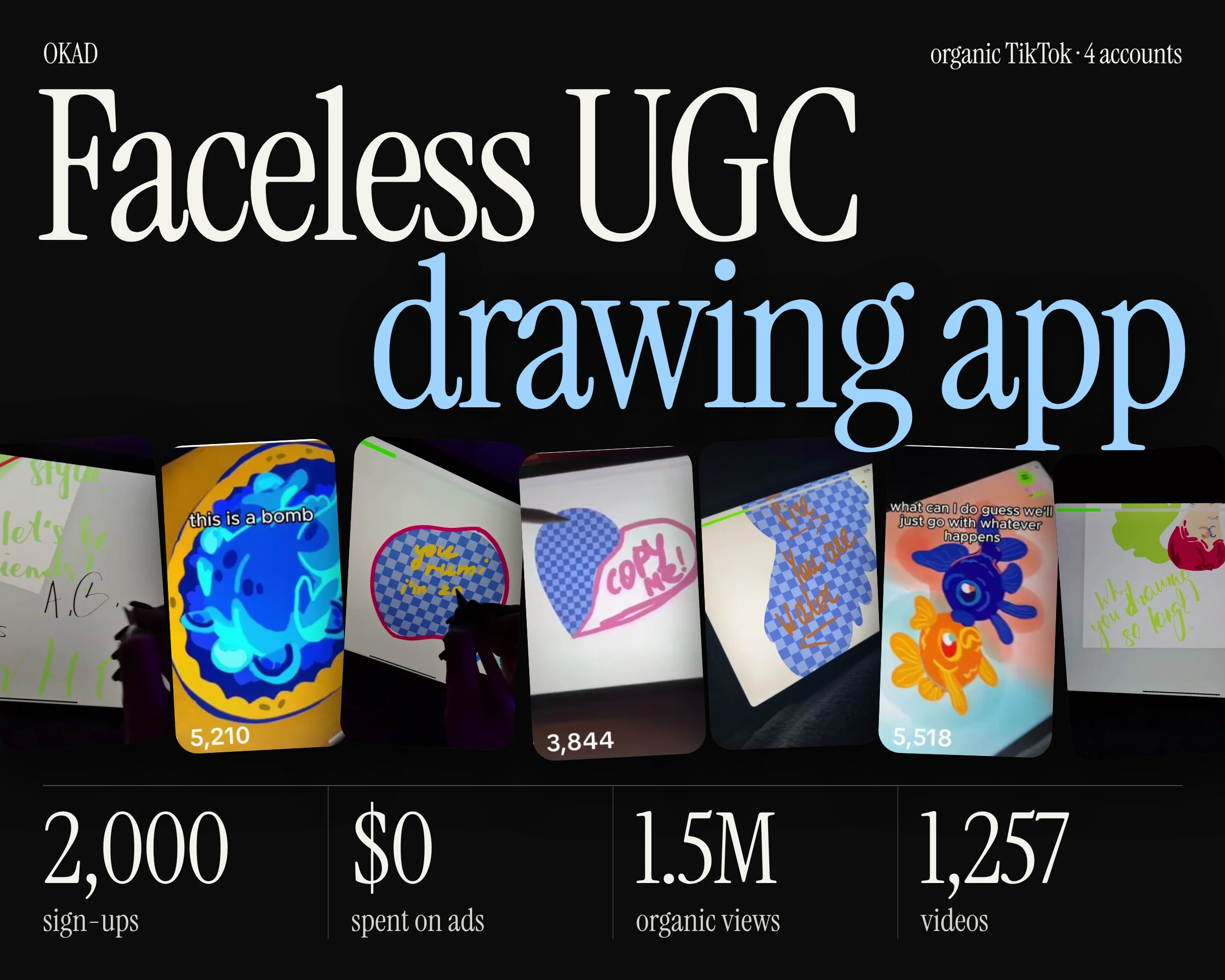
Character-driven content at scale — OKAD’s faceless UGC pipeline generated 1.5M organic views for a drawing app. See the case study.
Work With OKAD
OKAD produces illustrated and animated ad creatives as part of a full creative strategy service — research, briefs, production, and testing in one retainer. No per-asset pricing. No retainer lock-in.
See pricing and book a call · Or email olga@okad.agency with your monthly ad spend and goals.
Questions people ask
How do you keep an AI cartoon character consistent across scenes?
Three techniques: First, create a detailed character reference sheet with front, side, and three-quarter views plus multiple expressions — use this as an image reference for every generation. Second, use the same style keywords and seed values across all prompts. Third, use image-to-image generation rather than text-to-image for new scenes — feed the existing character image and describe only the new pose or environment. Even with these techniques, expect 30-40% of generations to need regeneration for consistency.
How much does it cost to create a brand mascot with AI?
Initial character design costs $200-$500 with AI tools (2-4 hours of iterative generation and refinement). A full character sheet with expressions, poses, and style guide costs $500-$1,000. Compare this to $10,000-$25,000 from a traditional character design studio. Ongoing content production with the character costs $100-$300 per scene once the design is locked.
Can I trademark an AI-generated character?
The legal landscape is evolving. In the US, purely AI-generated images generally cannot be copyrighted, but a character that is substantially refined, edited, and art-directed by a human likely can be. The safest approach: use AI to generate initial concepts, then have a human illustrator refine the final character design. This creates a clear chain of human authorship. Consult an IP attorney for your specific situation.
What makes a good brand character for marketing?
Four qualities: distinctiveness (recognizable in a thumbnail), simplicity (few details means more consistent AI generation), expressiveness (the face can convey different emotions clearly), and brand alignment (the character's personality matches your brand voice). The most successful brand characters work as silhouettes — if you can recognize them from the outline alone, the design is strong enough.
How many content pieces can one AI character produce per month?
With a locked character design and established style guide, a single designer can produce 30-50 unique scenes per month using AI tools. Each scene takes 30-60 minutes once the workflow is established. For social media series, this means daily posts with a consistent character — a volume that would require a dedicated illustrator at $4,000-$6,000 per month if done traditionally.