UGC and AI Content Production for Alcohol Brands — Compliance-First Approach
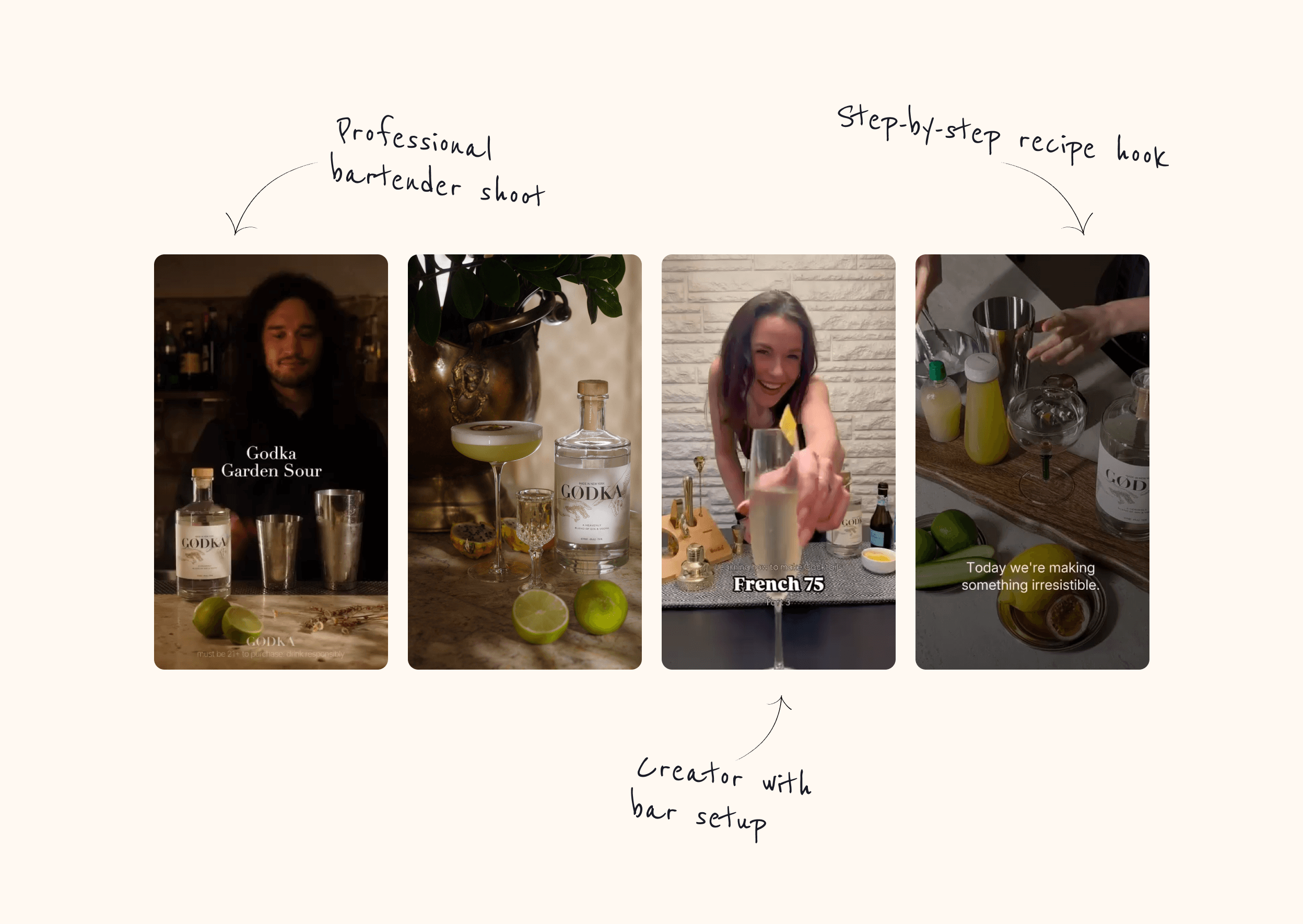
Most brands underestimate what goes into a single cocktail video. Your creator needs a full bar setup — shakers, jiggers, proper glassware. Fresh ingredients for every recipe — limes, herbs, syrups, all out of pocket. Steady hands on camera, because pouring shots with shaky hands ruins the take. A setup that looks premium, not a cluttered kitchen counter. And multiple takes to get that perfect pour, garnish drop, or ice crack.
This is not “hold the product and talk to camera.” It is mini food production. Most brands burn through 5-10 creators before finding one who can actually deliver.
Godka — Premium Alcohol Brand, 200K-900K Organic Views
Godka is a premium alcohol brand. We ran full production in Lisbon — professional bartender on set, controlled bar environment, cocktail shoots. Creator sourcing for alcohol UGC is a rare and difficult niche.
What works in alcohol UGC comes down to two things:
1. A vetted creator network for alcohol content. We built ours through trial and error — we know who has the setup, the hands, and the eye for detail. The vetting process for alcohol creators is fundamentally different from standard UGC: you need someone who can handle a Boston shaker, knows the difference between a julep strainer and a Hawthorne strainer, and can pour a clean 1.5oz shot on camera without looking down.
2. A proper production shoot — one day, controlled environment, a professional bartender on set. We walked away with 20+ videos you can cut for Reels, TikTok, Stories, and ads for months. The same posts were also used as paid ads tied to the website, and they drove actual sales.
Organic results: 200K, 300K, 600K, 700K, 900K views across individual posts. These are not aggregate numbers — individual posts hitting these view counts because the content quality matched what the algorithm rewards: visually stunning, pacing that holds attention, and aspirational lifestyle content that people save and share.
AI Cocktail Visuals — The Production Multiplier
The same AI visual production system we used for Dadadababy’s baby furniture applied to Godka’s alcohol content — but with a different creative direction.
For Dadadababy, AI visuals placed cribs in styled NYC nurseries. For Godka, AI-generated cocktail imagery extended the production shoot output: different bar settings, seasonal cocktail presentations, and visual variations that would have required multiple expensive shoots to produce traditionally.
The parallel is direct: Dadadababy’s AI sessions cost under $700 vs $3,000-8,000 for traditional shoots, producing 20-30 variations. For alcohol brands, where every reshoot requires fresh ingredients, a professional bartender, and a controlled environment, the cost savings are even more dramatic.
Slow-paced editing was critical. Most DTC video ads use fast cuts — 1-2 second shots, rapid transitions, high energy. For premium alcohol, we deliberately slowed the pace: shots lingered for 3-5 seconds, audio leaned on ambient sounds — ice clinking, liquid pouring, background conversation — and the overall rhythm communicated sophistication rather than urgency.
Compliance — Age Verification and TTB Requirements
Alcohol advertising operates under strict regulations that most UGC agencies are not equipped to handle. The Alcohol and Tobacco Tax and Trade Bureau (TTB) in the US sets specific guidelines, and platform-specific age-gating requirements add another layer.
Creator age verification: Every creator in an alcohol campaign must be age-verified. This is not just about the creator looking old enough — there is a documentation process that must be completed before any content is published.
Content restrictions: No depiction of excessive consumption. No content suggesting alcohol improves social, athletic, or sexual performance. No content directed at or appealing primarily to people under the legal drinking age.
Platform compliance: Meta, TikTok, and YouTube each have their own alcohol advertising policies layered on top of federal regulations. Content must be age-gated at the platform level, and creative cannot violate platform-specific rules even if it technically meets TTB guidelines.
Compliance Parallels — Dadadababy and Longevity Supplements
Regulated product advertising is not unique to alcohol. Two other campaigns required similar compliance navigation:
Dadadababy (baby furniture): Safety certification callouts (JPMA, CPSC, ASTM) had to be integrated into creative without dominating the visual hierarchy. Parents buying $500+ cribs check safety credentials — the creative needed to surface this information naturally, not as a disclaimer buried in fine print.
Longevity supplements (men 40+): Supplement advertising cannot make medical claims. The educational storytelling approach — featuring a real doctor with AI organ visualizations — walked the line between informative and compliant. Watch time of 15+ seconds confirmed the educational approach held attention without crossing into medical territory.
The skill set that handles TTB compliance for alcohol also handles FDA supplement guidelines and CPSC safety requirements for baby products. Regulated product advertising is a specialty, not a generic service.
Why Most Agencies Fail at Alcohol UGC
The failure rate is high because agencies treat alcohol UGC like any other product category:
- Creator sourcing: They send a brief to creators who have never made a cocktail on camera. The creator does not own a jigger. The first video comes back with a shaky pour against a kitchen counter with dishes in the background.
- Production quality: Fast-cut, high-energy editing that works for DTC supplements does not work for premium alcohol. The pacing communicates the brand.
- Compliance gaps: Content gets flagged or pulled because the agency did not verify creator age, did not review TTB guidelines, or did not age-gate at the platform level.
- No bartending expertise: The difference between a recipe video that looks amateur and one that looks professional is bartending technique. We solved this by putting a professional bartender on set.
Frequently Asked Questions
Why is alcohol UGC so much harder to produce than other product categories?
Every shoot requires a full bar setup (shakers, jiggers, proper glassware), fresh ingredients, a creator with actual bartending skills, a premium-looking environment, and multiple takes for perfect pours. Most UGC creators don't have the tools, space, or precision.
How do you handle TTB compliance for alcohol advertising content?
We verify every creator's age, review all content against TTB guidelines before publishing, ensure no depictions of excessive consumption or restricted claims, and implement platform-specific age-gating on Meta, TikTok, and YouTube.
Can AI visuals work for alcohol brands given the strict regulations?
Yes. AI-generated cocktail visuals extend production shoot output — different bar settings, seasonal presentations, visual variations — without additional physical shoots. The AI visuals are product-focused (cocktails, ingredients, bar setups) rather than lifestyle content with people, which simplifies compliance.
Like this work?
Let's discuss your project — we'll prepare a strategy and estimate within 48 hours.
Book a Call