Supplement Ad Creatives: Hook Testing Framework
The hook testing framework behind 200+ supplement ads across 6 brands. 2 creators x 4 hooks = 12 variations from one shoot. Real data from Swiss Skincare, Gut Health, and more.
Most supplement brands produce ads the same way: brief a creator, get a video back, run it until performance drops, repeat. The problem is not the creator or the product. The problem is the absence of a testing framework that turns one piece of footage into a system of testable hypotheses.
Over the past 18 months, we produced 200+ supplement ad creatives across six brands — from a women’s health line to a Swiss skincare operation running 30 ads per day. The common thread is not budget or category. It is a modular approach to hooks that lets every shoot compound into dozens of variations, and every variation teach something specific.
This article breaks down the framework.
The 2x4 Hook Testing Framework
The clearest example comes from a women’s health supplement brand. The challenge: produce enough creative to test meaningfully without commissioning new shoots.
The framework is simple arithmetic:
- 2 creators — different demographics, different delivery styles
- 4 hook angles — symptom-led, authority-led, curiosity-led, social proof
- 1 shared body — the product story stays constant
- Result: 12 testable variations from existing footage

Each variation isolates one variable: the opening. When variation 3A outperforms 3B, you know the hook angle matters — not the creator, not the edit, not the product claim. This precision is what separates testing from guessing.
The 12 variations shipped without a single new shoot day. Every clip came from footage already in the drive. The only new work was scripting four hook angles and editing the first 3–5 seconds of each ad.
Why Hooks Matter More Than Bodies
Three seconds. That is the window where a supplement ad lives or dies on Meta and TikTok. The body of the ad — product explanation, social proof, CTA — only matters if the viewer stays past the hook.
In our data across six supplement brands:
| Metric | Product-First Hook | Symptom-First Hook | Difference |
|---|---|---|---|
| Thumb-stop rate | 22–28% | 35–45% | +15–30% |
| Average watch time | 4.2s | 7.8s | +85% |
| Click-through rate | 0.8% | 1.4% | +75% |
The pattern is consistent. When you open with the product — brand name, jar shot, ingredient list — the viewer scrolls. When you open with a feeling they recognize — the 3 PM energy crash, the bloating after every meal, the skin that will not clear — they stop.
This is not a creative philosophy. It is a measurable phenomenon. And it means the highest-leverage edit you can make to any supplement ad is the first three seconds.
Hook Swap System: Swiss Skincare at Scale
The women’s health framework works for brands testing 10–20 variations per month. But what happens when you need 30 ads per day?
A Swiss skincare brand gave us that problem. At peak, the operation looked like this:
- 10+ new videos per day
- 3+ hooks per video
- 30 ads per day into the testing pipeline
- 2–3 months of stable, continuous orders
The system that made this possible: hook swaps. The body of each ad — product demonstration, creator testimonial, results footage — was treated as a fixed module. Hooks were treated as interchangeable cartridges.
When a hook underperformed (thumb-stop rate below 25%), it was replaced. The body stayed. No re-editing. No new brief. Just a new opening spliced onto an existing winner.
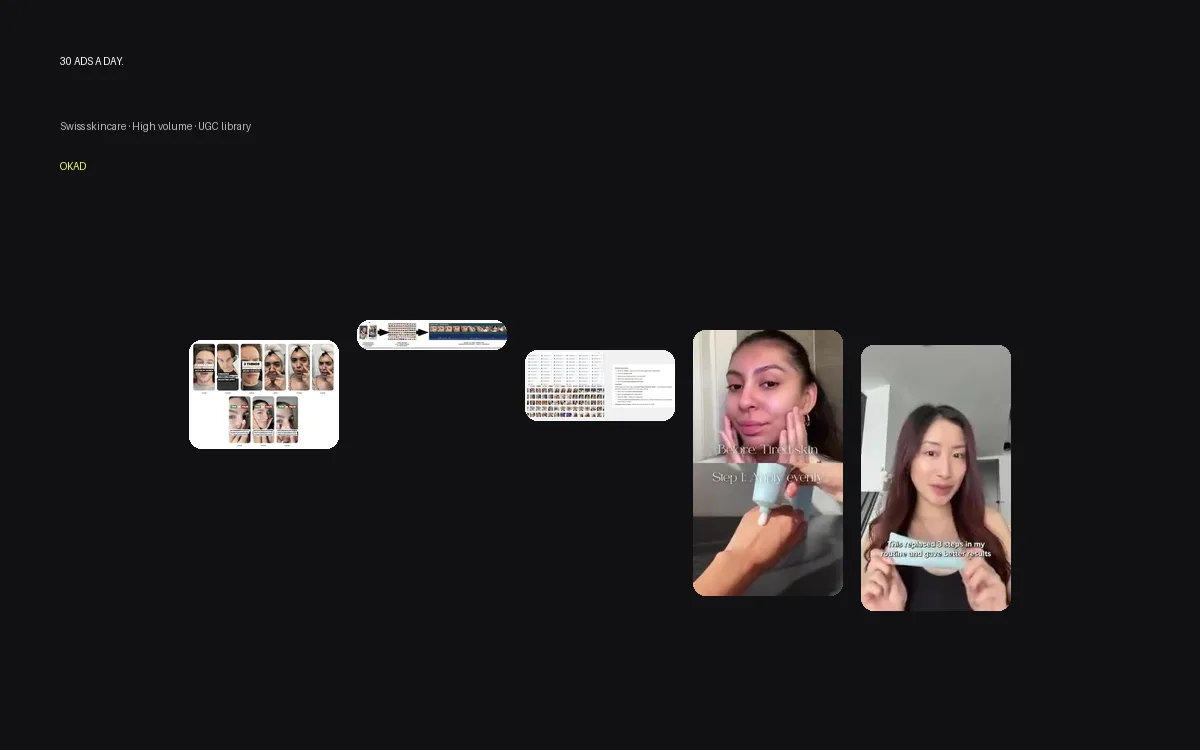
The creative team maintained a library of hundreds of UGC clips in Drive. Every clip was tagged by angle, creator, and format. When a new hook was needed, the editor pulled from the library, cut a 3-second opening, and attached it to the best-performing body. Total turnaround: under 30 minutes per variation.
What This Looks Like Operationally
| Component | Volume | Refresh Cadence |
|---|---|---|
| Hook library | 100+ clips | Added weekly |
| Body modules | 20–30 proven edits | Refreshed monthly |
| CTA variants | 5–8 closers | Rotated biweekly |
| Daily output | 10+ new videos | Continuous |
| Testing pipeline | 30 ads/day at peak | Daily launches |
The economics shift dramatically. Instead of paying $500–$1,500 per finished ad, the cost per variation drops to $50–$150 when you are recombining existing modules. At 30 ads per day, that difference is the line between profitable scaling and burning budget on production.
The 3-Hook-Per-Video System
Between the 12-variation framework and the 30-ads-per-day machine sits a middle ground that works for most supplement brands: three hooks per video.
We used this with a daily gel supplement brand — gut health, skin, and energy in one product. The numbers:
- 16 creator videos filmed
- 3 hook versions per video scripted by angle
- 48 ads to test from the initial production round
Each creator received the same product brief but a different angle script. Creator 1 led with gut health. Creator 2 led with skin clarity. Creator 3 led with energy. Creator 4 led with the daily ritual angle. Then each video received three hook treatments:
- Direct claim — “This changed my gut in two weeks”
- Question hook — “Why does your stomach bloat after every meal?”
- Pattern interrupt — A visual or statement that breaks the scroll
The 48 ads entered a structured testing protocol. Week one: all 48 at minimum viable spend. Week two: top 12 get increased budget. Week three: top 4 scale. The losers become data — their hooks get analyzed for what did not resonate, informing the next round of scripts.
Five Formats That Work for Supplement Creatives
Format variety matters as much as hook variety. Audiences respond differently to structure, not just messaging. From a skincare brand (Breakout Aid), we deployed six creators across five distinct formats — 15 new ads total, zero new shoots:
-
Sizzle reel — Fast cuts, product texture close-ups, before/after flashes. Works for top-of-funnel awareness. Highest thumb-stop rate in our tests (40%+ average).
-
Before/after story — Creator walks through their journey. 30–60 seconds. Works for mid-funnel consideration. Highest completion rate (55%+ average).
-
ASMR/texture — Close-up application, sounds, sensory detail. Skincare and supplement brands with a physical product ritual. Surprisingly strong click-through rates — viewers who watch ASMR content are already in a buying mindset.
-
Store launch/unboxing — First impression format. Works for new product launches and retargeting. Creates urgency without discount language.
-
How it’s made — Ingredient sourcing, manufacturing process, quality proof. Works for premium supplement positioning. Builds trust with skeptical buyers who have seen too many influencer endorsements.
The key finding: format and hook interact. A symptom-first hook paired with a before/after format outperformed the same hook paired with a sizzle reel by 2.3x on conversion rate. Testing hooks in isolation is necessary. Testing hook-format combinations is where the real wins hide.
The Role of AI B-Roll in Supplement Ads
Three of our six supplement cases used AI-generated b-roll — visuals showing what happens inside the body when you take the product. Gut lining repair. Cellular absorption. Nutrient pathways. These are visuals that would cost $10,000–$50,000 to produce with traditional medical animation.
For a gut health brand, we produced 8 AI b-roll clips per month alongside 20 ad edits. The b-roll served a specific narrative function: it bridged the gap between “I feel bloated” (the hook) and “this product fixes it” (the CTA). The mechanism visual — showing the gut lining responding to the supplement — gave the viewer a reason to believe the claim.
For a pet supplement brand (Tipaw), AI b-roll showed what happens inside a dog’s gut when they eat grass, lick excessively, or scratch constantly. The visual made an invisible problem visible. And it converted a 60-second story ad into something viewers watched to the end because they wanted to understand what was happening to their dog.
The production math: one AI b-roll clip costs $100–$300 and takes 1–2 days. One traditional medical animation costs $5,000–$15,000 and takes 2–4 weeks. At 8 clips per month, the annual savings exceed $50,000.
Building Your Supplement Ad Testing Framework
The framework scales in three tiers:
Tier 1: Starting (5–15 ads/month)
- Use the 2x4 model: 2 creators, 4 hooks, 1 body
- Produce 12 variations per round
- Test weekly, scale winners biweekly
- Investment: $2,000–$5,000/month in creative
Tier 2: Scaling (15–50 ads/month)
- Use the 3-hook system: every video gets 3 openings
- Add format variety (3–5 formats in rotation)
- Introduce AI b-roll for mechanism visuals
- Investment: $5,000–$12,000/month in creative
Tier 3: At Scale (50+ ads/day)
- Use the hook swap system: modular library, daily output
- Maintain a tagged clip library (100+ assets)
- Replace underperforming hooks without re-editing bodies
- Dedicated editor on rotation for daily output
- Investment: $12,000–$25,000/month in creative
Each tier builds on the previous one. You do not skip to Tier 3. You earn it by running Tier 1 long enough to know which hooks, formats, and creators work for your product.
Common Mistakes in Supplement Creative Testing
Testing too many variables at once. If you change the hook, the body, the creator, and the CTA simultaneously, you learn nothing. Isolate one variable per test. The hook testing framework exists specifically to hold everything else constant.
Producing complete ads instead of components. Every finished ad should be three modules — hook, body, CTA — that can be recombined. If your editor delivers a single timeline that cannot be split, you are paying for one ad when you could have paid for ten.
Waiting for performance to drop before producing new creative. By the time your CPA rises 30%, you have already lost 2–3 weeks of scale. Build a production calendar that delivers new hooks before the old ones fatigue — every 7–14 days for Meta, every 5–10 days for TikTok.
Ignoring format as a variable. A hook that fails in a sizzle reel may win in a before/after story. The same message lands differently depending on structure. Test hook-format combinations, not just hooks.
Spending on new shoots when the footage library is untapped. Before commissioning new creator content, audit what you already have. In every case we have worked on, the existing footage library contained 2–3x more testable combinations than the brand realized.
What a Month Looks Like
Here is the actual production cadence from our gut health brand engagement — a US-based brand producing at Tier 2 scale:
| Week | Activity | Output |
|---|---|---|
| Week 1 | Hook scripting + AI b-roll production | 4 hook scripts, 2 AI clips |
| Week 2 | Editing round 1 — new hooks on proven bodies | 8–10 new variations |
| Week 3 | Performance review + format experiments | 5–6 format variations |
| Week 4 | Winner scaling + next month’s angle research | 3–4 scaled ads, angle map |
| Monthly total | ~20 edits, 8 AI clips, 4 story formats |
Every edit was produced from existing footage. Zero new shoots that month. The four story formats — red flags, gut-brain connection, week-by-week progress, and gift story — each served a different stage of the buyer journey.
The Compounding Effect
The real advantage of a hook testing framework is not efficiency — though producing 48 ads from 16 videos instead of producing 48 individual ads saves tens of thousands of dollars. The real advantage is learning speed.
Every hook test generates data. Every data point informs the next round of scripts. After three months, you do not need to guess which angles resonate. You have a ranked list of hooks by thumb-stop rate, watch time, and conversion — segmented by audience, platform, and format.
That ranked list is the most valuable asset in your creative operation. It makes every future shoot more effective, every script more precise, and every dollar of production spend more likely to produce a winner.
Six brands. Two hundred ads. One framework. The math works the same whether you are testing 12 variations a month or launching 30 a day. Start with the hook. Test it in isolation. Let the data tell you what to scale.
Questions people ask
How many ad variations do supplement brands need per month?
It depends on spend level. At $10K–$30K/month media spend, aim for 15–25 new variations. At $50K+, you need 30–50+ to stay ahead of creative fatigue. Modular hook testing lets you generate these volumes from existing footage — no new shoots required.
What is hook testing in supplement advertising?
Hook testing is isolating the first 2–5 seconds of an ad while keeping the body and CTA identical. You test different opening angles — symptom-led, authority-led, curiosity-led, social proof — against the same product story. This reveals which message earns attention, not which edit looks best.
How do you create supplement ads without new video shoots?
Start with existing creator footage and modular editing. Separate hooks from bodies. Use AI b-roll for mechanism visuals (gut lining, cellular absorption, skin layers). Combine these components into new variations. We produced 48 testable ads from 16 creator videos for one supplement brand using this approach.
What hook types work best for supplement ads?
Symptom-first hooks consistently outperform product-first hooks in our data. Leading with a feeling the viewer recognizes — bloating, energy crashes, skin texture — earns 15–30% higher thumb-stop rates than opening with the product name or ingredients. The product earns its place after the viewer feels understood.
How long before supplement ad creatives fatigue?
Most supplement ads on Meta fatigue within 7–14 days at scale. On TikTok, the window is even shorter — 5–10 days. This is why continuous hook production matters more than occasional big shoots. A hook swap system lets you refresh the opening without re-editing the entire ad.