Pre-Launch Marketing: 1K Users Before Product
How two SaaS brands built 1,000+ user bases before launch with $0.11 CPC, 600K reach, and $547 total ad spend. The pre-launch playbook with real numbers.
Most founders wait until their product is ready to start marketing. By then, they are launching into silence — no audience, no email list, no social proof. The first week of signups trickles in. Paid ads burn budget on cold audiences. The product is good, but nobody knows it exists.
The alternative is building your audience before you build your product. Two SaaS brands — Upstream and Cosmowiki — did exactly this, reaching 1,000+ users and 600K+ combined reach before their products went live. One spent $547 total. The other achieved $0.11 CPC on paid campaigns. Neither had a finished product to show.
Here is what actually worked, with real numbers.
The Problem With Launch-Day Marketing
Traditional launch marketing follows a linear path: build the product, then find the audience. This model has three structural problems.
First, you have zero data on messaging. Without months of content testing, you are guessing which value propositions resonate. Your launch copy is based on assumptions, not validated hooks.
Second, paid acquisition is expensive against cold audiences. CPCs for SaaS products on Meta typically range from $0.50 to $2.00+. Without warm audiences built through organic content, every click costs maximum price.
Third, you have no social proof. An Instagram account with 47 followers does not inspire confidence. A waitlist page with no visible traction does not convert. Early users need to see that other people are already interested.
Pre-launch marketing solves all three problems simultaneously: you test messaging through content, build warm audiences for cheaper paid acquisition, and create visible traction that compounds.
Case 1: Upstream — 1,000 Users, $0.11 CPC, Zero Product Shots
Upstream is a SaaS platform for automated YouTube live streaming. When they came to us, they had a working prototype but nothing public — no brand, no social media, no audience. The founder needed to stay focused on product development, which meant we had to build the entire marketing engine without relying on the founder for content creation.
The starting point: literally zero. No social accounts, no email list, no brand identity.
The constraint: no finished product to screenshot, demo, or show in ads. Everything had to communicate the concept without showing the thing itself.

What We Built
We started with a two-week brand sprint: visual identity, tone of voice, content pillars, and template systems in Figma. The brand needed to feel established from day one — a pre-launch account that looks like a weekend project does not build trust.
For content production, we used three formats that did not require a finished product:
- Animation — Explainer-style motion graphics showing the concept of automated live streaming. These communicated the “what” without needing real UI.
- Professional video — Talking-head and B-roll content about the problem Upstream solves (manual live streaming is expensive and unsustainable).
- Figma templates — Carousel and story templates that the team could populate with new messaging without needing a designer for each post.
This system kept the founder focused on product while we published content 5-6 times per week on Instagram, with cross-posting to TikTok and YouTube Shorts.
The Paid Strategy
Organic content built the baseline. Paid amplification scaled what worked.
We ran Meta ads with two objectives: reach campaigns to build awareness, and traffic campaigns to drive waitlist signups. The key metric: $0.11 cost per click. For context, the SaaS industry average CPC on Meta is $0.50-$1.50 depending on the niche.
How we got there:
- Organic testing first. We published 40+ Reels before spending a dollar on ads. The top-performing organic posts became our ad creatives — we already knew which hooks and formats resonated.
- Warm audience targeting. We built custom audiences from Instagram engagers, video viewers, and website visitors. These warm audiences converted at 3-5x the rate of cold lookalikes.
- DM automation. Users who commented on posts received automated DMs with a waitlist link. This converted passive engagement into email captures without manual work.
Results
- 1,000 users on the waitlist before product launch
- 600K+ reach across Instagram and paid campaigns
- $0.11 CPC on Meta ads (4-5x below industry average)
- Brand built from zero — the founder never had to become a content creator
Case 2: Cosmowiki — 1,000 Followers, $547 Total Spend
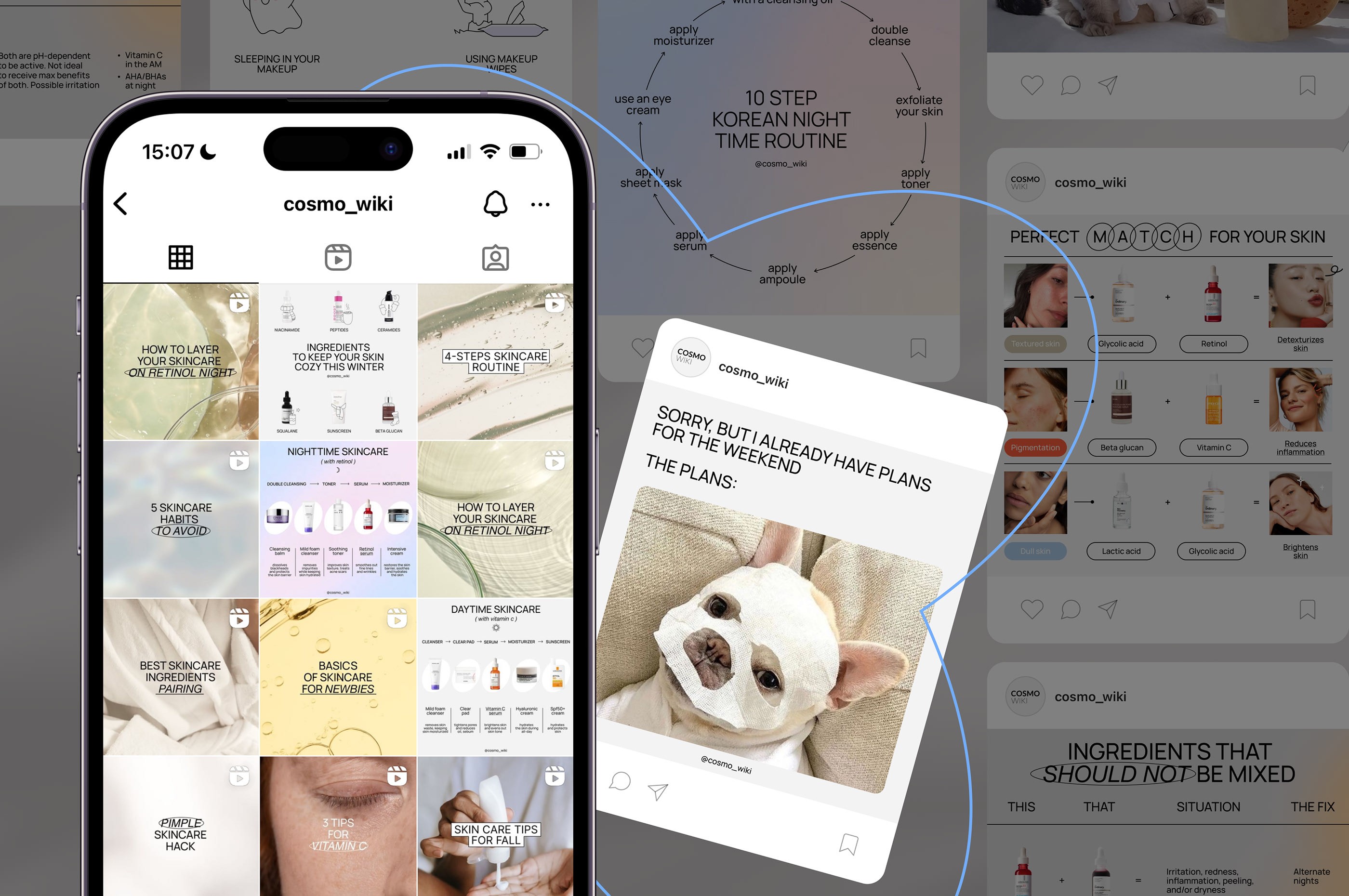
Cosmowiki is a cosmetic research IT platform targeting the German-speaking market. The challenge was different from Upstream: a highly specific niche (cosmetic ingredient research), a non-English audience, and an even tighter budget.
The starting point: no brand, no social presence, no audience.
The market: Germany, Austria, Switzerland — a market where cosmetic consumers are educated, skeptical, and research-driven.
The Content Strategy
We led with education. Instead of promoting the platform (which was not yet ready), we published content about cosmetic ingredients, research findings, and industry myths. This positioned Cosmowiki as an authority before the product existed.
The content mix:
- Instagram Reels — Short educational videos about specific ingredients (hyaluronic acid, retinol, niacinamide). These hit the intersection of “content people actually search for” and “topics that position the brand.”
- Carousel posts — Deep-dive breakdowns of ingredient research, formatted for saves and shares.
- Stories — Behind-the-scenes development updates and polls to build community engagement.
The top-performing Reel hit 43K views — remarkable for a brand-new account in a niche German-language market.
The Paid Strategy
Total ad spend: $547. That is not a monthly budget — that is the entire campaign spend over two months.
The breakdown:
- $0.11 CPC on traffic campaigns
- $0.31-$0.84 cost per follower depending on the campaign
- Focus on Instagram follower growth campaigns and Reels engagement campaigns
We kept spend low deliberately. The organic content was working — paid was used to accelerate momentum, not replace it. Every ad creative was a repurposed top-performing organic post.
DM Automation
Both Upstream and Cosmowiki used Instagram DM automation as a conversion layer. Here is how it worked:
- A Reel includes a call-to-action: “Comment [keyword] to get early access.”
- Users who comment receive an automated DM with a signup link.
- The DM sequence includes 2-3 follow-up messages over the next 48 hours.
This turned engagement metrics into pipeline metrics. A Reel with 10K views and 200 comments could generate 150+ DM conversations and 50+ email signups — automatically.
Results (2 Months)
- 1,000+ followers from zero
- 600K+ reach across organic and paid
- 12K+ likes and 3,800+ saves
- Top Reel: 43K views
- $547 total ad spend ($0.11 CPC, $0.31-$0.84 per follower)
The Pre-Launch Framework: What to Build First
Both cases followed the same underlying framework, despite targeting different markets and audiences. Here is the sequence.
Week 1-2: Brand Foundation
Before publishing anything, build the infrastructure:
- Visual identity (logo, color system, typography)
- Content templates in Figma (Reels covers, carousel templates, story templates)
- Tone of voice document
- Content pillars (3-4 topic categories)
- Bio, highlights, and profile optimization
This phase is non-negotiable. Launching content without a cohesive brand makes every subsequent post work harder.
Week 3-6: Organic Content Sprint
Publish daily. The goal is not perfection — it is velocity and data.
- Reels: 4-5 per week. Educational content about the problem you solve. Test different hooks, formats, and lengths.
- Carousels: 2-3 per week. Deep-dive content that earns saves.
- Stories: Daily. Behind-the-scenes, polls, questions — anything that drives DM conversations.
Track which hooks get views, which topics get saves, and which CTAs get comments. After 30-40 posts, you have real data on what resonates.
Week 5-8: Paid Amplification
Once organic data tells you what works, amplify it:
- Take your top 5-10 organic posts and run them as ads.
- Start with engagement and reach objectives ($5-10/day).
- Build custom audiences from engagers and video viewers.
- Layer in traffic campaigns to your waitlist ($10-20/day).
- Activate DM automation on high-engagement posts.
The total budget for this phase can be as low as $300-500. You are not buying cold traffic — you are accelerating organic momentum.
Week 8-12: Conversion and Scale
By this point, you should have:
- A warm audience of followers and engagers
- An email/waitlist of 200-500+ people
- Data on which messages, hooks, and formats convert
- Social proof (follower count, engagement, testimonials)
Now you can scale paid acquisition with confidence. Your CPCs will be lower (warm audiences), your conversion rates will be higher (tested messaging), and your launch will have momentum instead of silence.
Budget Reality: What Pre-Launch Marketing Actually Costs
The biggest misconception about pre-launch marketing is that it requires a large budget. Here are the real numbers from both cases.
| Metric | Upstream | Cosmowiki |
|---|---|---|
| Starting point | Zero — no brand, no audience | Zero — no brand, no audience |
| Timeline | ~3 months | 2 months |
| Total ad spend | Not disclosed (low) | $547 |
| CPC | $0.11 | $0.11 |
| Cost per follower | — | $0.31-$0.84 |
| Users/followers acquired | 1,000 | 1,000+ |
| Total reach | 600K+ | 600K+ |
The production costs are higher than the ad spend — brand design, content creation, video editing, and DM automation setup. But the media budget itself can be remarkably small when organic content does the heavy lifting.
What Most Founders Get Wrong
Waiting for the product. Every month you delay marketing is a month of audience-building lost. Your competitors are not waiting.
Leading with features. Pre-launch content should focus on the problem, not the solution. You do not have a product to show — but you have a pain point to articulate. That is enough.
Posting without a system. Random content published twice a week will not build momentum. You need daily-or-near-daily publishing, a template system for production efficiency, and DM automation to convert engagement into leads.
Skipping the brand sprint. A pre-launch account that looks amateur undermines everything you publish. Two weeks of brand work pays for itself in every subsequent post.
Treating paid as primary. Paid amplification works when it accelerates organic momentum. Running cold ads without organic traction is expensive and inefficient — the $0.11 CPCs only happened because warm audiences were built organically first.
When to Start
The ideal time to start pre-launch marketing is 2-3 months before your planned launch date. This gives you enough time to build the brand, test content, activate paid amplification, and reach a meaningful audience size.
If your launch is further out, start earlier — the data you collect will make your launch strategy sharper. If your launch is sooner, compress the timeline but do not skip the brand foundation.
The worst time to start marketing your product is the day it launches. By then, you are already behind.
Questions people ask
How much does pre-launch marketing cost?
Based on our two cases, pre-launch marketing can cost as little as $547 total (Cosmowiki) to build 1,000+ followers with 600K+ reach. Upstream achieved $0.11 CPC on paid campaigns. The key is a Reels-first organic strategy supplemented by targeted paid amplification — not large media budgets.
How long does it take to build a pre-launch audience?
Both Upstream and Cosmowiki reached the 1,000-user milestone within 2-3 months. Cosmowiki hit 1,000+ followers, 12K+ likes, and 3,800+ saves in just 2 months. The timeline depends on content velocity, niche specificity, and whether you use DM automation to convert engaged viewers into subscribers.
Can you build an audience without a finished product?
Yes — both cases prove this. Upstream had no product to show and relied on animation, professional video, and Figma templates to create content that demonstrated the concept. Cosmowiki used educational content about cosmetic research to attract their target audience. The strategy is to lead with the problem you solve, not the product itself.
What is DM automation and how does it help pre-launch?
DM automation sends a pre-written direct message to users who engage with your content (comments, story replies, specific keywords). Both Upstream and Cosmowiki used this to convert passive viewers into active leads — capturing email addresses and building waitlists without manual outreach. It turns engagement into pipeline automatically.
What content works best for pre-launch marketing?
Instagram Reels consistently outperformed other formats in both campaigns. Cosmowiki's top Reel hit 43K views. The formula: educational hooks about the problem your product solves, behind-the-scenes development updates, and social proof through early user testimonials. Frequency matters — daily or near-daily posting builds algorithmic momentum.