Organic Reels Strategy: 800K Views, Zero Ad Spend
How 5 brands hit 800K-1.5M views on Instagram Reels without ad spend. B-roll systems, faceless content, geo-signal hacks, and the formats that actually scale.
Spending money on ads is not the problem. Spending money on ads before you know what content actually resonates — that is the problem. Every brand we work with that has scaled paid campaigns successfully did one thing first: they figured out what works organically.
Here are five cases where organic Reels drove hundreds of thousands to millions of views with zero ad spend. The budgets were near zero. The results were not.
Case 1: YourChristianDate — 800K Views From a B-Roll System
YourChristianDate is a dating platform for Christian singles. Their top-performing Reel hit 800,000 views. Not from a viral stunt or a celebrity cameo — from a b-roll system designed to produce 60 videos per month at a consistent quality level.
How the B-Roll System Works
The production pipeline has three stages. First, creators film raw footage: one-liner hooks delivered to camera and everyday b-roll clips — walking into a church, opening a Bible, having coffee with friends. No scripts longer than one sentence. No studio lighting. Phone cameras only.
Second, that raw footage ships to editors who assemble the final Reels. One-liner audio over relevant b-roll, text overlays, trending sounds when appropriate. The editors work from a format library — proven structures that get recycled with fresh footage.
Third, the finished videos post on a schedule. Sixty per month means roughly two per day, giving the algorithm a constant stream of content to test and distribute.

The Format That Broke Through
The “first-timer in church” series became the biggest hit. The format was simple: a creator walks into a church for the first time, films their genuine reactions, adds a voiceover about the experience. It worked because it combined relatability (many people are curious about attending church) with authenticity (real reactions, not scripted performances).
The key insight: the best-performing content in the entire 60-video monthly pipeline was the least produced. Raw footage, genuine reactions, minimal editing. The algorithm and the audience both rewarded authenticity over polish.
Case 2: Drawing App — 1.5M Views Without a Single Face
A drawing app was getting roughly 100 downloads per week. Decent, but not growing. The marketing challenge: how do you create engaging video content for a tool where the entire experience is a person drawing on an iPad?
The answer was faceless POV content. Every video showed the same setup: a hand holding an Apple Pencil, an iPad screen, and the drawing taking shape in real time. No face. No voiceover in most videos. Just the drawing process with text overlays and music.
Why Faceless Works
Faceless content removes the biggest friction point in content creation: finding someone willing to be on camera. It also makes the content infinitely reproducible. Any team member with an iPad can film. There is no dependency on a specific creator’s schedule, appearance, or personality.
The format that performed best was multiplayer drawing. Two hands, two pencils, one canvas. One person draws something, the other person has to complete it or respond to it. This format created natural tension and resolution in every video — the viewer watches to see how the second person reacts to what the first person drew.
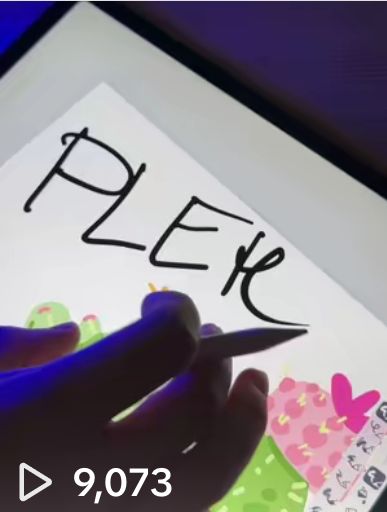
Result: 1.5M organic views. Downloads increased from a baseline of roughly 100 per week. The entire content operation required an iPad, a phone mount, and a pencil.
The drawing app case demonstrates a broader principle: product-as-content. When the product experience is inherently visual and satisfying to watch, the content almost creates itself. The key is finding the angle that turns a utility (a drawing tool) into entertainment (a drawing challenge). That transformation — from functional to watchable — is what makes faceless content scalable across product categories.
Case 3: Skribly — 1,257 Videos, 1.5M Views, and the Geo-Signal Hack
Skribly is an online multiplayer drawing game. The organic content strategy was built on sheer volume: 1,257 videos published, generating 1.5M views and approximately 2,000 new user registrations.
Volume as Strategy
Most brands post 3-5 Reels per week and expect results. Skribly treated content like a testing lab. With over 1,200 videos, they had enough data to identify exactly which formats, hooks, durations, and posting times drove the most views and conversions.
The top-performing formats were gameplay clips with reaction text overlays — short clips of funny moments during multiplayer drawing rounds. These were easy to produce (screen recordings with text) and infinitely variable (every game produces new moments).
The Geo-Signal Approach
One tactical decision made a measurable difference: posting from US-based devices to trigger Tier 1 geo-distribution. Instagram’s algorithm considers the posting location as a signal for initial audience distribution. Content posted from a US location gets shown to US audiences first — and US audiences drive higher engagement rates, which triggers broader distribution.
Skribly used US-based posting for their primary content, and the difference in reach compared to non-US posting was significant enough that it became a standard part of their workflow.
Result: 1.5M views, 2,000 registrations, format playbook that could sustain indefinite content production.
Case 4: Twinsfit — 127K Views From 485 Followers
Twinsfit is a fitness account that had 485 followers when these results were achieved. Not 485,000 — four hundred and eighty-five. They hit 127,000 views on their content with a 6.12% engagement rate.
This case matters because it disproves the most common excuse for not investing in organic content: “We do not have enough followers.” Follower count is nearly irrelevant for Reels distribution. Instagram shows Reels to non-followers based on content quality signals, not audience size. A 485-follower account can reach 127,000 people if the content hits the right format and engagement triggers.
The engagement rate of 6.12% is particularly telling. Industry average for fitness content on Instagram sits around 1-3%. Twinsfit tripled that because small, engaged audiences interact at higher rates — and those interactions signal to the algorithm that the content deserves wider distribution.
For brands hesitating to start organic content because their account is small: Twinsfit’s 485 followers reached 260 times their follower count. The math is straightforward — on Reels, distribution is earned by content quality, not bought by follower count. Starting with zero followers is not a disadvantage if the format is right.
Case 5: by.okad — 81.8K Views on Camera Roll Content
This is our own account. We practice what we recommend.
The best-performing Reel on by.okad hit 81,800 views. The production budget was zero dollars. The content was shot on phone cameras, edited in-app, and posted without any paid promotion.
The topics that performed: behind-the-scenes looks at UGC production, hiring tech creators, and day-in-the-life content from a creative agency. The format was camera roll style — intentionally casual, no professional lighting, no tripods, no color grading.

Why this matters for agencies: If our own organic content did not work, we would have no business advising clients on theirs. The by.okad account is a live testing ground for every format and strategy we recommend.
Additional Proof Points
Two more cases that reinforce the pattern:
Ziax: A dead account — no posting activity for months — published 12 videos and hit 4,948 views in the first 4 days. The algorithm does not penalize dormant accounts as heavily as people think. Fresh, format-correct content gets distributed regardless of account history. This is relevant for any brand that paused content and worries they need to “warm up” the account before expecting results. You do not. Post good content and the algorithm responds.
Godka: Consistent posting in a proven format drove 200,000 to 900,000 views per post. Not per month — per individual post. The takeaway: once you find a format that works, scaling is about consistency, not reinvention. Godka’s results also highlight the compounding effect of organic content — each high-performing post grows the audience, which gives the next post a larger base of engaged followers to trigger initial engagement, which signals the algorithm to distribute more broadly.
The System Behind the Results
Every case above followed the same underlying process, whether the brand knew it or not.
Step 1: Competitive Research
Before creating a single video, study what is already working in your niche. Not what big accounts post — what small accounts post that gets disproportionate views. A 500-follower account with a 50K-view Reel has found a format that works. Study that format.
Look at the top 20 Reels in your niche from accounts with under 10,000 followers. Note the format (talking head, POV, b-roll, screen recording), the hook structure (question, statement, visual), the length, and the engagement pattern (comments asking questions vs. tags vs. saves). This research takes 2-3 hours and prevents weeks of guessing.
Step 2: Format Testing
Create 10-15 videos across 3-4 different formats. Faceless POV. Talking head. B-roll with text. Screen recording with voiceover. Post them all within two weeks. The data will tell you which format your specific audience responds to.
Do not judge results after one video per format. Each format needs 3-4 attempts before the data is meaningful. A talking head video can flop because of a weak hook, not because the format is wrong. Test the format multiple times with different hooks before ruling it out.
Step 3: Volume
Once a format clicks, produce as much of it as possible. Skribly posted 1,257 videos. YourChristianDate produces 60 per month. Volume is not about flooding the feed — it is about giving the algorithm enough content to distribute and giving yourself enough data to optimize.
Build a production pipeline that can sustain your target volume without burning out the team. Batch filming (recording 10-20 videos in one session) is more efficient than filming one video at a time. Batch editing follows the same logic. The goal is a factory, not an artisan workshop.
Step 4: Iteration
The first version of a winning format is never the best version. Track which hooks get the highest 3-second retention. Track which video lengths get the most completions. Track which CTAs drive profile visits or link clicks. Adjust one variable at a time.
Why Unpolished Content Wins
The common thread across all five cases: the best-performing content was not the most polished. YourChristianDate’s top Reel was raw b-roll. The drawing app used phone-recorded screen captures. by.okad filmed on phone cameras with no professional equipment.
This is not an argument against quality. It is an argument against over-production. Instagram’s algorithm optimizes for engagement, and engagement comes from content that feels real, relatable, and worth interacting with. A perfectly lit, professionally edited Reel can feel like an ad — and users scroll past ads.
The sweet spot is content that looks authentic but is structurally intentional. The hook is crafted. The pacing is deliberate. The CTA is placed correctly. But the footage itself feels like it came from a real person’s camera roll, not a production studio.
Consider the numbers side by side. YourChristianDate’s most-produced, highest-budget content performed well — but the 800K-view Reel was a simple b-roll assembly. The drawing app could have invested in professional animation and motion graphics — but the hand-with-pencil format at a fraction of the cost generated 1.5M views. Production value has diminishing returns past a quality floor that is much lower than most brands assume.
The Content Production Math
Understanding the economics makes the case clearer. A single professionally produced Reel — scriptwriter, talent, location, lighting, sound, editing — can cost $500-2,000. At YourChristianDate’s pace of 60 videos per month, that would mean $30,000-120,000 monthly just for content.
Their actual approach: creators film raw footage on their phones (cost per creator per batch is a fraction of studio production), editors assemble the Reels from a format library (efficient, repeatable), and the whole operation runs at a volume that would be impossible at professional production costs.
Skribly’s 1,257 videos at professional production rates would have been a budget-breaking project. At their actual cost structure — screen recordings with text overlays — the cost per video was negligible, and the return on those 1.5M views and 2,000 registrations was substantial.
The brands winning on organic Reels are not outspending their competition. They are out-systematizing it. A content factory that produces 60 passable videos per month will outperform a brand that produces 4 polished videos per month — because the algorithm rewards consistency and the factory generates more data for optimization.
When to Start and What to Expect
Organic Reels strategy is not a quick fix. Expect 2-4 weeks of format testing before anything clicks. Plan for 30-50 posts before you have enough data to identify winners. Budget for consistent production — not one batch of 10 videos, but an ongoing pipeline.
The minimum viable setup is simpler than most brands expect: a smartphone with a decent camera, a ring light or natural lighting, one editing app (CapCut handles most needs), and a content calendar. No studio. No professional equipment. No agency required for the first testing phase.
Here is a realistic timeline for what to expect:
- Week 1-2: Competitive research and first batch of test videos. Post 10-15 Reels across multiple formats. Expect modest results — this phase is about data, not virality.
- Week 3-4: Analyze what worked. Double down on the top 1-2 formats. Refine hooks and pacing based on retention data. Start building a production rhythm.
- Month 2-3: Volume phase. Post 3-5 Reels per week in your proven format. Track which variations outperform. Build a library of hooks, transitions, and CTAs that work for your audience.
- Month 3+: Optimization and scaling. Your best organic performers become templates for paid amplification. You now have data on what converts, not guesses.
The payoff is a content engine that generates views, engagement, and conversions without ad spend. Once a format is proven organically, it becomes the foundation for paid campaigns that scale with confidence — because you already know the content works.
Every dollar spent amplifying content that has not been validated organically is a gamble. Every dollar spent amplifying content with proven organic performance is an investment. Start with organic. Prove the format. Then scale.
Questions people ask
How many Reels should I post per week to grow organically?
Consistency matters more than volume, but our best results come from 3-5 Reels per week minimum. Skribly posted 1,257 videos and hit 1.5M views. Volume gives the algorithm more data points and your team more format insights.
Do I need to show my face in Reels to get views?
No. Our drawing app case study hit 1.5M organic views with zero faces — just hands, an iPad, and text overlays. Faceless POV content works especially well for product demonstrations, tutorials, and creative tools.
What is the geo-signal hack for Instagram Reels?
Posting from a US-based device or using US geo-signals tells the algorithm to distribute your content to Tier 1 audiences first. Skribly used this approach and saw significantly higher reach compared to posting from non-US locations.
How long does it take to see results from organic Reels?
Expect 2-4 weeks of testing before formats start clicking. Ziax saw 4,948 views in the first 4 days from 12 videos on a dead account. But most brands need 30-50 posts to identify their winning format through iteration.
Is organic Reels strategy still worth it in 2026?
Yes. Instagram continues to prioritize short-form video in its algorithm. Our cases show that raw, authentic content consistently outperforms polished production — which means the barrier to entry is lower, not higher.