Dating App Marketing: UGC That Converts 40+
How three dating apps used completely different UGC strategies to reach singles 40+. 60+ videos, 800K-view Reels, and script refreshes over the same creators.
Most dating app ads look the same. A young creator points at the camera, lip-syncs a trending sound, and tells you to download the app. That works when your audience is 22. It does not work when your audience is 45, divorced, and skeptical that any app will change their Saturday nights.
Over the past year, we produced UGC campaigns for three dating apps owned by the same parent company. Each app targeted a different slice of the 35+ market. Each required a completely different content strategy. The results taught us more about mature-audience marketing than any amount of trend research could.
This is what we learned — and the specific systems that made each campaign work.
The Problem With Dating App UGC for Older Audiences
Dating apps spend billions on advertising. Most of that creative is built for users under 30 — fast cuts, trending audio, high-energy hooks. The assumption is that UGC is UGC, and the same playbook scales across demographics.
It does not. Here is what happens when you run standard UGC for a 40+ audience:
- Hook rates drop. Trend-based hooks (pointing, transitions, “watch this”) feel juvenile to older viewers. They scroll past.
- Trust erodes. Overly polished or scripted content triggers skepticism. This audience has been marketed to for decades. They recognize a pitch.
- Engagement stays shallow. Likes without saves, views without clicks. The content entertains but does not convince anyone to download.
The fix is not better targeting. It is fundamentally different content — different formats, different creator profiles, different scripts, and different production models.
Case 1: Dating.com — 7 Formats, 60+ Videos, 5 Months
The brief: Dating.com and its companion app Zendate needed content for TikTok and Instagram targeting singles 40+. Not paid ads — organic feed content that would build the brand’s social presence from near-zero.
The challenge: No existing content library. No proven formats. No data on what this audience responds to on short-form video platforms.
What We Built
Over five months, we developed a full production pipeline:
- 60+ videos delivered across the campaign
- 7 distinct formats tested and refined
- Full-service production — scripts, casting, creator briefing, editing
- Content split between Dating.com TikTok and Zendate Instagram
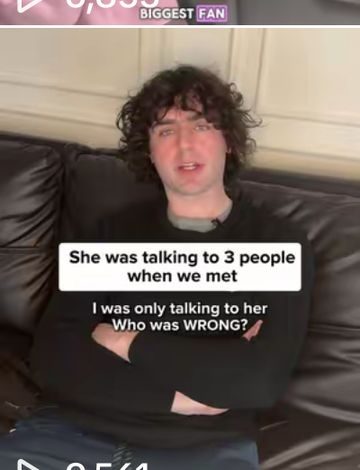
The seven formats ranged from talking-head stories (“my first date after divorce”) to man-on-the-street interviews to quiet lifestyle vignettes. We wrote every script, cast every creator, and briefed every shoot.
What Worked for 40+
Three formats outperformed the rest:
- Story-driven talking heads. Creators sharing real (or realistic) dating experiences. No trending sounds, no fast cuts. Just someone talking to camera about something the viewer has felt. These had the highest save rates.
- Interview format. “What is the worst dating app experience you have had?” Real answers from real-looking people. High comment engagement because viewers wanted to share their own stories.
- Quiet lifestyle content. A creator getting ready for a date, choosing an outfit, texting back. No voiceover, just ambient sound and subtitles. This worked specifically on Instagram for Zendate.
The formats that underperformed were the ones closest to standard UGC — trend-based hooks, fast transitions, and product-feature callouts. The audience did not reject the app. They rejected the format.
The Production Insight
Casting was the hardest part. The creator pool for 40+ content is thin. Most UGC creators are 20-30 years old. Finding creators who looked and spoke like the target audience — and could deliver on camera — required screening three times more candidates than a typical campaign.
The scripts had to walk a line between relatability and aspiration. Too real (“dating at 45 is exhausting”) and the content depresses. Too aspirational (“I found love in a week”) and nobody believes it. The sweet spot was honest optimism: “It is awkward at first. Then it gets fun.”
Case 2: YourChristianDate — The B-Roll System That Hit 800K Views
The brief: YourChristianDate needed a high-volume content pipeline for Instagram. The budget could not support ordering finished UGC videos at scale.
The solution: Instead of buying finished videos, we ordered raw footage — one-liners to camera and a library of everyday b-roll. Editors assembled the final videos in-house.
The B-Roll Economics
Traditional UGC ordering works like this: you pay a creator $150-$400 to deliver a finished 30-60 second video. You get one video per payment. If you need 60 videos a month, the math gets painful fast.
The b-roll model inverts the cost structure:
| Model | Cost Per Video | Monthly Output | Monthly Cost |
|---|---|---|---|
| Finished UGC | $150–$400 | 15–20 videos | $3,000–$8,000 |
| B-roll + one-liners | $40–$80 | 60 videos | $2,400–$4,800 |
We ordered two types of raw material from creators:
- One-liners — short statements to camera (“I never thought I would try online dating,” “My friends set up my profile”) delivered without editing or transitions.
- B-roll library — everyday footage: walking to church, cooking dinner, reading in a park, morning coffee. No script, just authentic daily moments.
Editors combined these elements into polished videos at a rate of 60 per month — three times the output at roughly half the cost of finished UGC.
The 800K-View Hit
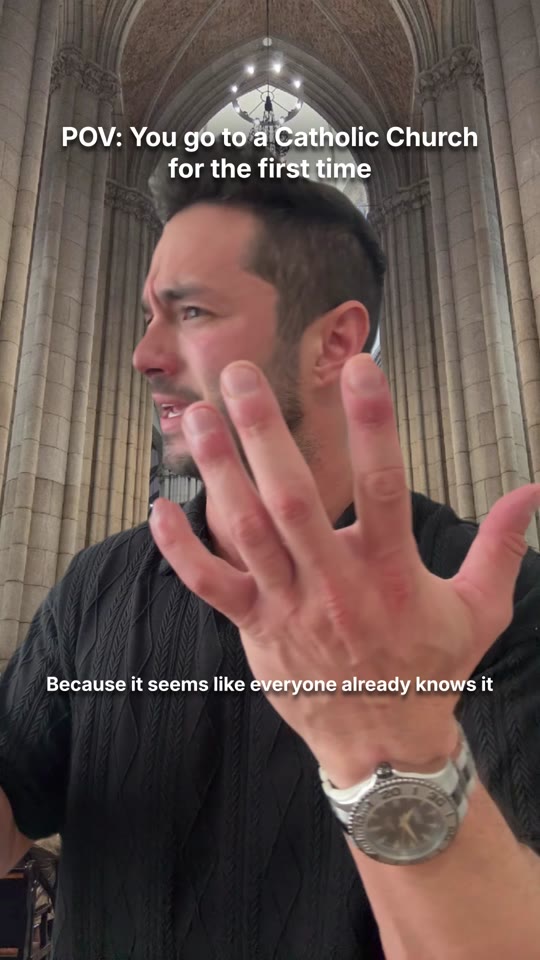
One series changed the trajectory of the account. We shot “first-timer in church” — a creator visiting a church for the first time, capturing genuine reactions and moments. It was shot as b-roll with minimal scripting.
One Reel from this series reached 800,000 views. It worked because:
- Authenticity was undeniable. The creator’s reactions were real. No acting, no script.
- The topic resonated beyond dating. People shared it for the church experience, not the app. This expanded reach far beyond the target audience.
- Low production value was the feature. Polished content would have killed the moment. The slightly shaky, observational footage felt like a friend’s Instagram story.
This single series generated more engagement than months of conventional content. The lesson: for niche dating apps, content that speaks to the community’s identity (not just the app’s features) outperforms everything else.
Case 3: DateMyAge — 24 Scripts Over 22 Familiar Faces
The brief: DateMyAge had data showing their best-performing ads all featured the same 22 creators. The instinct was to find new faces. We argued against it.
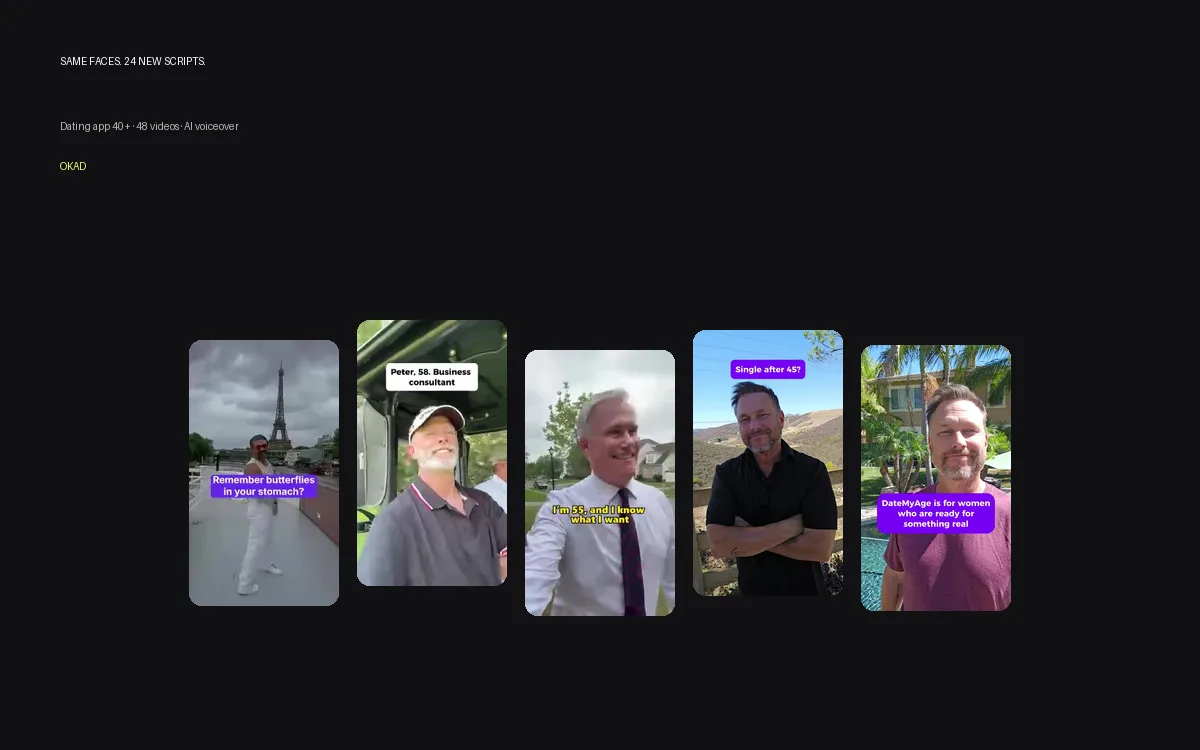
The approach: Write 24 new scripts and lay them over existing footage from the 22 proven creators. Every script cut for two apps — DateMyAge and its sister app — producing 48 videos total.
Why Same Faces Beat New Faces
Most brands assume creative fatigue means audience fatigue with the creator. Our data showed the opposite for DateMyAge:
- Viewers recognized the creators. Repeat exposure to the same faces built implicit trust. New faces reset that trust to zero.
- The fatigue was in the message, not the messenger. The same hooks and scripts had worn out. The creators themselves were still effective.
- Production cost dropped to near-zero. No new shoots, no new casting, no new onboarding. Just writing and editing.
The Delivery
- 24 new scripts written for existing footage
- 48 videos — each script cut for two apps
- 7 scripts with AI voiceover — for concepts where the original creator audio did not fit the new angle
- 22 creators reused from proven winners
The AI voiceover scripts were an experiment. Instead of re-recording the creator, we used AI voice to deliver new copy over the existing b-roll and talking-head footage. This worked for informational and list-style formats (“3 reasons dating after 50 is better”) but not for emotional storytelling, where voice authenticity matters.
Three Strategies, One Framework
These three campaigns look different on the surface. Dating.com was a ground-up production. YourChristianDate was a b-roll assembly line. DateMyAge was a script refresh. But they share a framework that applies to any dating app targeting older audiences:
1. Cast for Trust, Not Trend
Every creator in these campaigns looked like someone the target audience would meet at a dinner party. No influencer aesthetic. No ring lights and studio setups. The casting criteria were: age-appropriate, natural on camera, and able to deliver a line without sounding like they are reading.
2. Write for Skeptics
The 40+ audience assumes dating apps do not work for them. Every script had to acknowledge that skepticism before pitching the solution. The strongest hooks were variations of “I did not think this would work either” — which is the opposite of the aspirational hooks that work for younger demographics.
3. Build for Volume
All three campaigns were designed to produce volume — not through bigger budgets, but through smarter production models. The b-roll system (YourChristianDate), the script refresh (DateMyAge), and the multi-format pipeline (Dating.com) each solved the volume problem differently. The common thread: separate content creation from content assembly.
What Does Not Work for 40+ Dating App Marketing
Based on twelve months of data across these three apps:
- Trend-chasing content. TikTok trends cycle in 3-7 days. By the time a 40+ audience discovers a trend, it is already over. Build evergreen formats instead.
- Feature-focused ads. “We have verified profiles” and “advanced matching algorithm” do not move this audience. They have heard every feature claim from every app. Lead with emotion, not features.
- Young creator proxies. Casting a 28-year-old to “play” 42 does not work. The audience spots it immediately, and it signals that the brand does not understand them.
- Single-format campaigns. One format fatigues faster than platform-wide fatigue. Running only talking-head content burns out in 2-3 weeks. Rotate across 4-5 formats minimum.
The Budget Reality
Dating app UGC for mature audiences is not more expensive than standard UGC — it is just structured differently. Here is the actual cost breakdown across these three projects:
| Approach | Output | Cost Structure |
|---|---|---|
| Full production (Dating.com) | 60+ videos, 7 formats | Scripts + casting + editing, 5-month engagement |
| B-roll system (YourChristianDate) | 60 videos/month | Raw footage orders + in-house editing |
| Script refresh (DateMyAge) | 48 videos | Writing + editing only, zero production |
The most cost-efficient model was YourChristianDate’s b-roll system. The highest creative control was Dating.com’s full production. DateMyAge’s script refresh delivered the fastest turnaround. Each model fits a different stage of a dating app’s content maturity.
Building Your Dating App Content Pipeline
If you are marketing a dating app to users over 35, start here:
- Audit your existing footage. Before ordering anything new, inventory what you have. You may be sitting on a DateMyAge scenario — proven creators with exhausted scripts.
- Test the b-roll model on one platform. Order raw footage from 3-5 creators and have editors assemble 10-15 videos. Compare cost-per-video and engagement against your current finished-UGC approach.
- Write scripts that acknowledge skepticism. The hook should make the viewer feel understood, not sold to. “Dating after 40 is weird” beats “Find your perfect match” every time.
- Cast from the audience. Your creators should be indistinguishable from your users. If your target audience would not swipe right on the creator, the content will not convert.
- Plan for format rotation. Budget for 4-5 distinct formats from day one. Single-format campaigns burn out fast with older audiences who value variety over repetition.
The dating apps that win with older demographics are not spending more. They are spending differently — on systems that produce authentic, high-volume content that speaks to an audience tired of being marketed to like everyone else.
Questions people ask
What type of UGC works best for dating app marketing?
For mature audiences (35+), authentic conversational formats outperform trend-driven content. In our work with Dating.com, talking-head videos where creators shared real dating stories had 3x the engagement of scripted product demos. The content needs to feel like a conversation, not a commercial.
How many UGC videos does a dating app need per month?
It depends on the number of platforms and audience segments. Dating.com required 60+ videos across 7 formats over 5 months for TikTok and Instagram. YourChristianDate maintained 60 videos per month using a b-roll production system. At minimum, plan for 15-20 new videos monthly to stay ahead of creative fatigue.
Is it cheaper to order raw footage or finished UGC videos?
Raw footage is significantly cheaper per output video. YourChristianDate ordered one-liners and b-roll from creators instead of finished videos, then had editors assemble 60 videos per month from the library. The cost per video drops by 60-70% compared to ordering each video as a finished deliverable.
Can you reuse the same creators in dating app ads?
Yes, and sometimes you should. DateMyAge found that their best-performing ads featured the same 22 creators. Instead of replacing them, we wrote 24 new scripts over the existing footage and produced 48 videos. Familiar faces build trust, especially with older audiences who value consistency.
Why does standard UGC fail for dating apps targeting older audiences?
Standard UGC relies on trends, fast cuts, and young creator energy that reads as inauthentic to a 40+ audience. Older singles are skeptical of dating apps by default. Content needs to address real concerns — safety, quality of matches, social stigma — in a tone that feels peer-to-peer, not performative.