High ROAS UGC Ads
Every script follows a Multiple Hooks → Body → CTA structure engineered for watch time and keeps viewers past the 15-second mark through storytelling — not selling.
Marketing
0
min reading
Most UGC ads lose viewers by second 3. The creative looks authentic, the creator is likeable, but the script has no structure — no reason to keep watching.
The result: wasted spend and ROAS that never climbs past break-even.
High-ROAS UGC ads solve this with a specific script architecture: multiple hooks at the top, a body that earns attention through storytelling, and a CTA placed at peak engagement. Every element is engineered for watch time — because watch time is what platforms reward with cheaper distribution.
Why Most UGC Ads Fail at ROAS
The problem isn't production quality or creator selection. It's script structure. Most brands hand creators a brief that says "talk about the product" — and the result is a 30-second monologue that viewers skip in 2 seconds. The ads that drive measurable ROAS share three structural elements:
Multiple hook variations tested per script — not one opening, but 3-4, each designed to stop a different segment of the audience
A body that uses storytelling (problem → discovery → result) instead of feature listing
CTAs placed at the moment of peak emotional engagement, not bolted onto the end
The Multiple Hooks → Body → CTA Framework
This is the script architecture OKAD Agency uses across every UGC ad project. It's not a creative philosophy — it's an engineering decision based on platform algorithms and viewer behavior data.

Hooks (first 1-3 seconds): Each script gets 3-4 hook variations. One might lead with a question ("I was spending $200/month on skincare until..."), another with a bold claim ("This replaced my entire morning routine"), another with a pattern interrupt (unexpected visual or sound). The hooks are modular — they can be swapped without reshooting the body of the ad. This means one production day generates dozens of testable combinations.
Body (seconds 3-20): The body earns the next 15 seconds through narrative structure, not product features. The viewer stays because they want to know what happened — not because they care about ingredients or specs. Storytelling formats that consistently outperform: personal transformation ("here's what changed"), unexpected discovery ("I wasn't looking for this but..."), and social proof narrative ("my friend told me to try this and I didn't believe her").
CTA (seconds 15-30): The CTA lands when the viewer is most invested in the story — typically right after the transformation reveal or the social proof payoff. "Link in bio" at peak engagement converts 3-5x better than the same CTA at the end of a flat product demo.
How Longevity Used Storytelling to Hold Viewers Past 15 Seconds
Longevity (supplements for men 40+, Europe-to-US market) faced a unique challenge: the product requires education. You can't sell longevity supplements with a 3-second hook and a discount code. The audience needs to understand why they should care — and that takes time. OKAD Agency built the entire creative testing framework from scratch, including what constitutes a test, A/B variation structure, winner identification criteria, and reporting templates.
The scripts used a doctor-figure storytelling format — an authority character walking the viewer through the science in plain language, supported by AI-generated organ visualizations that made abstract health concepts tangible.
The result: 15+ second average watch time on paid ads — well past the critical mark where platforms start rewarding the creative with cheaper impressions. Multilingual content (DE, DK, EN) with educational storytelling proved that even complex, education-heavy products can hold attention when the script is built around narrative, not features.
VueSwiss and InstaHeadshots: 3 Hook Variations Per Script at Scale
VueSwiss (Swiss skincare) and InstaHeadshots (AI headshot generator) both operate at high creative volume — and both prove that the multiple-hooks model scales.
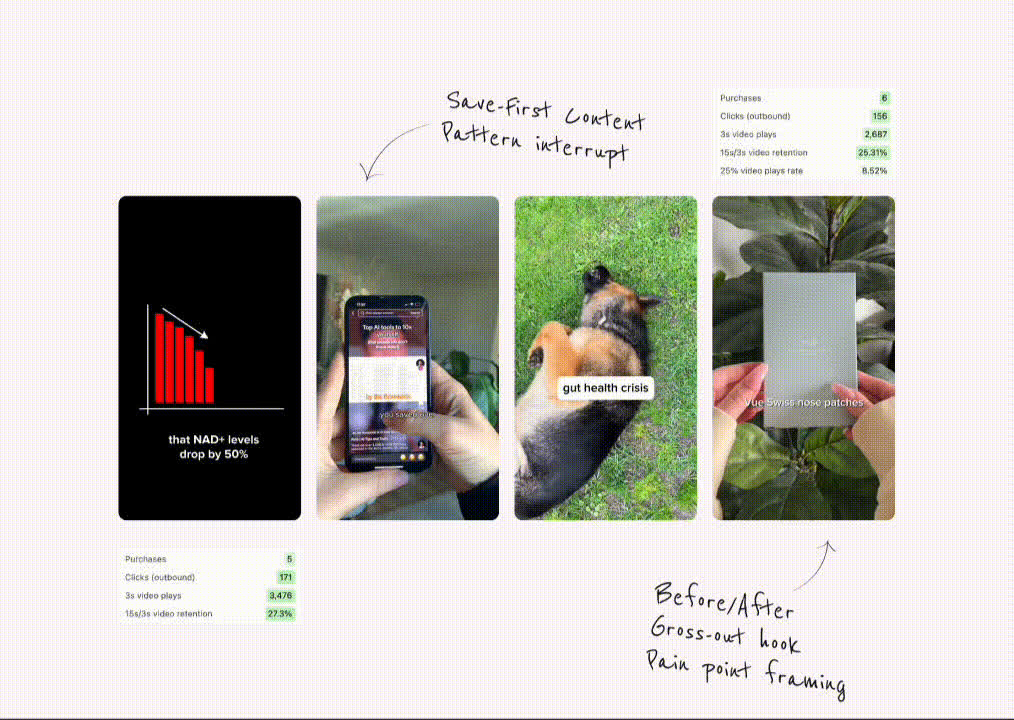
VueSwiss produces ~30 videos per day: 10+ base scripts, each with 3+ hook variations, sustaining stable order volume for 2-3 months running. The hooks aren't random — each variation targets a different audience segment or emotional trigger. One hook might lead with vanity ("your skin after 2 weeks"), another with skepticism ("I didn't believe Swiss skincare was worth the price"), another with social proof ("my dermatologist recommended this").
InstaHeadshots follows the same framework: 70 scripts across talking head, voiceover, and music+text formats — each with 3 distinct hook variations. The hooks are tested systematically: which opening drives the highest view-to-15-second retention, which converts to clicks, which produces the best CPA. The modular structure means creative testing velocity stays high without proportional increases in production cost.
Lookalikey and ZenToes: Strong Hooks + Dynamic Editing
Some products need more than a good script — they need editing that matches the energy of the hook. Lookalikey (AI photo app) and ZenToes (foot care, Walmart launch) both required creative where the editing itself became part of the hook.
For ZenToes, OKAD Agency produced 10 static and 10 video ads using a modular hook-testing framework — 3-4 different hooks per video, each designed to stop the scroll in a commodity category where every competitor's ad looks the same. The editing approach: fast cuts between before/after shots, dynamic text overlays that reveal information in sync with the voiceover, and visual transitions timed to keep the viewer's eye moving. The result: 8%+ view-to-25-second retention rates — a benchmark most DTC brands struggle to reach at 4%.
Lookalikey's ads combine the same hook-testing methodology with editing designed for the AI/tech audience: screen recordings, transformation reveals, and side-by-side comparisons that demonstrate the product in real time. The dynamic editing style — quick cuts, zoom-ins on details, split-screen before/after — keeps engagement high through visual storytelling rather than verbal explanation.
Why Watch Time Drives ROAS
The connection between watch time and ROAS isn't philosophical — it's mechanical. Meta, TikTok, and YouTube all use watch time as a primary signal for ad quality scoring. Higher watch time = higher quality score = lower CPM = more impressions per dollar = better ROAS. The math is straightforward:
A 15-second ad with 80% completion rate gets dramatically cheaper distribution than a 15-second ad with 30% completion
Cheaper distribution means more impressions per dollar
More impressions at the same conversion rate = higher ROAS
The compounding effect: better watch time → cheaper CPMs → more data → faster optimization → even better ROAS
This is why script structure matters more than production quality. A well-structured UGC script shot on an iPhone will outperform a poorly structured studio ad every time — because the algorithm rewards the one people actually watch.
Measuring UGC Ad Performance
The metrics that matter for high-ROAS UGC campaigns:
View-to-15-second retention: The single most important leading indicator. If viewers aren't making it to second 15, the script structure needs work — not the creative polish.
Hook-through rate: What percentage of viewers make it past the first 3 seconds? Test this across all hook variations to identify winners.
CPA by hook variation: Different hooks attract different audience segments. Some hooks drive higher volume at higher CPA; others drive lower volume at lower CPA. The right choice depends on your scaling goals.
ROAS by creative: Track at the individual creative level, not the campaign level. One winning creative can carry an entire campaign — identify it fast and scale it.
Creative fatigue timeline: How many days before a winning creative's performance degrades? Plan your production calendar around this number.
The Production Model Behind Consistent ROAS
High ROAS isn't a one-time win — it requires a production system that generates testable creative at consistent velocity. OKAD Agency's model:
626+ vetted UGC creators across niches — matched by audience, not just category
Modular script architecture — every script designed for 3-4 hook swaps without reshooting
48-72 hour turnaround from brief to deliverable
Systematic hook testing — data decides winners, not creative instinct
Cross-platform optimization — same base creative adapted for TikTok, Meta, and YouTube Shorts
This infrastructure powered ZenToes' Walmart launch (20 ad variations from one production cycle), VueSwiss' sustained ~30 videos/day output, and Longevity's multilingual testing framework — each proving that ROAS scales with creative velocity, not creative budget.
OKAD Agency Services
OKAD Agency specializes in high-ROAS UGC ad production with a script-first methodology:
UGC script writing with Multiple Hooks → Body → CTA architecture
Hook testing and creative strategy (3-4 hooks per script, modular swapping)
Storytelling-driven scripts engineered for 15+ second watch time
High-volume production: VueSwiss (~30 videos/day), InstaHeadshots (70 scripts with 3 hook variations each)
Dynamic editing for hook-driven formats (fast cuts, before/after reveals, split-screen)
Creator sourcing from 626+ vetted UGC creators
Cross-platform optimization for TikTok, Meta, and YouTube
Performance tracking: view-to-15s retention, hook-through rate, CPA by variation, ROAS by creative
FAQs
What makes a UGC ad "high ROAS"?
A high-ROAS UGC ad combines strong watch time (driven by script structure, not production quality) with a CTA placed at peak engagement. The Multiple Hooks → Body → CTA framework consistently outperforms single-hook scripts because it allows systematic testing of which opening drives the best performance for each audience segment. OKAD Agency's campaigns achieve 8%+ view-to-25-second retention through this methodology.
How many hook variations should each UGC script have?
Three to four hook variations per script is the standard for systematic testing. Fewer than three doesn't generate enough data to identify winners; more than four creates diminishing returns relative to production cost. VueSwiss runs 3+ hooks per base script across ~30 videos per day — proving the model scales.
Why does watch time matter more than click-through rate?
Watch time directly affects your CPM. Platforms reward ads that hold attention with cheaper distribution — which means more impressions per dollar before a single click happens. A high-watch-time ad with a moderate CTR will outperform a low-watch-time ad with a high CTR on total ROAS, because the distribution cost advantage compounds across every impression.
How do you maintain ROAS as you scale creative volume?
The key is modular production: scripts designed so hooks can be swapped without reshooting, creators matched by audience segment, and systematic testing that lets data — not instinct — decide winners. OKAD Agency's model produces dozens of testable variations from each production cycle, keeping creative velocity high while controlling costs.
Most UGC ads lose viewers by second 3. The creative looks authentic, the creator is likeable, but the script has no structure — no reason to keep watching.
The result: wasted spend and ROAS that never climbs past break-even.
High-ROAS UGC ads solve this with a specific script architecture: multiple hooks at the top, a body that earns attention through storytelling, and a CTA placed at peak engagement. Every element is engineered for watch time — because watch time is what platforms reward with cheaper distribution.
Why Most UGC Ads Fail at ROAS
The problem isn't production quality or creator selection. It's script structure. Most brands hand creators a brief that says "talk about the product" — and the result is a 30-second monologue that viewers skip in 2 seconds. The ads that drive measurable ROAS share three structural elements:
Multiple hook variations tested per script — not one opening, but 3-4, each designed to stop a different segment of the audience
A body that uses storytelling (problem → discovery → result) instead of feature listing
CTAs placed at the moment of peak emotional engagement, not bolted onto the end
The Multiple Hooks → Body → CTA Framework
This is the script architecture OKAD Agency uses across every UGC ad project. It's not a creative philosophy — it's an engineering decision based on platform algorithms and viewer behavior data.

Hooks (first 1-3 seconds): Each script gets 3-4 hook variations. One might lead with a question ("I was spending $200/month on skincare until..."), another with a bold claim ("This replaced my entire morning routine"), another with a pattern interrupt (unexpected visual or sound). The hooks are modular — they can be swapped without reshooting the body of the ad. This means one production day generates dozens of testable combinations.
Body (seconds 3-20): The body earns the next 15 seconds through narrative structure, not product features. The viewer stays because they want to know what happened — not because they care about ingredients or specs. Storytelling formats that consistently outperform: personal transformation ("here's what changed"), unexpected discovery ("I wasn't looking for this but..."), and social proof narrative ("my friend told me to try this and I didn't believe her").
CTA (seconds 15-30): The CTA lands when the viewer is most invested in the story — typically right after the transformation reveal or the social proof payoff. "Link in bio" at peak engagement converts 3-5x better than the same CTA at the end of a flat product demo.
How Longevity Used Storytelling to Hold Viewers Past 15 Seconds
Longevity (supplements for men 40+, Europe-to-US market) faced a unique challenge: the product requires education. You can't sell longevity supplements with a 3-second hook and a discount code. The audience needs to understand why they should care — and that takes time. OKAD Agency built the entire creative testing framework from scratch, including what constitutes a test, A/B variation structure, winner identification criteria, and reporting templates.
The scripts used a doctor-figure storytelling format — an authority character walking the viewer through the science in plain language, supported by AI-generated organ visualizations that made abstract health concepts tangible.
The result: 15+ second average watch time on paid ads — well past the critical mark where platforms start rewarding the creative with cheaper impressions. Multilingual content (DE, DK, EN) with educational storytelling proved that even complex, education-heavy products can hold attention when the script is built around narrative, not features.
VueSwiss and InstaHeadshots: 3 Hook Variations Per Script at Scale
VueSwiss (Swiss skincare) and InstaHeadshots (AI headshot generator) both operate at high creative volume — and both prove that the multiple-hooks model scales.
VueSwiss produces ~30 videos per day: 10+ base scripts, each with 3+ hook variations, sustaining stable order volume for 2-3 months running. The hooks aren't random — each variation targets a different audience segment or emotional trigger. One hook might lead with vanity ("your skin after 2 weeks"), another with skepticism ("I didn't believe Swiss skincare was worth the price"), another with social proof ("my dermatologist recommended this").
InstaHeadshots follows the same framework: 70 scripts across talking head, voiceover, and music+text formats — each with 3 distinct hook variations. The hooks are tested systematically: which opening drives the highest view-to-15-second retention, which converts to clicks, which produces the best CPA. The modular structure means creative testing velocity stays high without proportional increases in production cost.
Lookalikey and ZenToes: Strong Hooks + Dynamic Editing
Some products need more than a good script — they need editing that matches the energy of the hook. Lookalikey (AI photo app) and ZenToes (foot care, Walmart launch) both required creative where the editing itself became part of the hook.
For ZenToes, OKAD Agency produced 10 static and 10 video ads using a modular hook-testing framework — 3-4 different hooks per video, each designed to stop the scroll in a commodity category where every competitor's ad looks the same. The editing approach: fast cuts between before/after shots, dynamic text overlays that reveal information in sync with the voiceover, and visual transitions timed to keep the viewer's eye moving. The result: 8%+ view-to-25-second retention rates — a benchmark most DTC brands struggle to reach at 4%.
Lookalikey's ads combine the same hook-testing methodology with editing designed for the AI/tech audience: screen recordings, transformation reveals, and side-by-side comparisons that demonstrate the product in real time. The dynamic editing style — quick cuts, zoom-ins on details, split-screen before/after — keeps engagement high through visual storytelling rather than verbal explanation.
Why Watch Time Drives ROAS
The connection between watch time and ROAS isn't philosophical — it's mechanical. Meta, TikTok, and YouTube all use watch time as a primary signal for ad quality scoring. Higher watch time = higher quality score = lower CPM = more impressions per dollar = better ROAS. The math is straightforward:
A 15-second ad with 80% completion rate gets dramatically cheaper distribution than a 15-second ad with 30% completion
Cheaper distribution means more impressions per dollar
More impressions at the same conversion rate = higher ROAS
The compounding effect: better watch time → cheaper CPMs → more data → faster optimization → even better ROAS
This is why script structure matters more than production quality. A well-structured UGC script shot on an iPhone will outperform a poorly structured studio ad every time — because the algorithm rewards the one people actually watch.
Measuring UGC Ad Performance
The metrics that matter for high-ROAS UGC campaigns:
View-to-15-second retention: The single most important leading indicator. If viewers aren't making it to second 15, the script structure needs work — not the creative polish.
Hook-through rate: What percentage of viewers make it past the first 3 seconds? Test this across all hook variations to identify winners.
CPA by hook variation: Different hooks attract different audience segments. Some hooks drive higher volume at higher CPA; others drive lower volume at lower CPA. The right choice depends on your scaling goals.
ROAS by creative: Track at the individual creative level, not the campaign level. One winning creative can carry an entire campaign — identify it fast and scale it.
Creative fatigue timeline: How many days before a winning creative's performance degrades? Plan your production calendar around this number.
The Production Model Behind Consistent ROAS
High ROAS isn't a one-time win — it requires a production system that generates testable creative at consistent velocity. OKAD Agency's model:
626+ vetted UGC creators across niches — matched by audience, not just category
Modular script architecture — every script designed for 3-4 hook swaps without reshooting
48-72 hour turnaround from brief to deliverable
Systematic hook testing — data decides winners, not creative instinct
Cross-platform optimization — same base creative adapted for TikTok, Meta, and YouTube Shorts
This infrastructure powered ZenToes' Walmart launch (20 ad variations from one production cycle), VueSwiss' sustained ~30 videos/day output, and Longevity's multilingual testing framework — each proving that ROAS scales with creative velocity, not creative budget.
OKAD Agency Services
OKAD Agency specializes in high-ROAS UGC ad production with a script-first methodology:
UGC script writing with Multiple Hooks → Body → CTA architecture
Hook testing and creative strategy (3-4 hooks per script, modular swapping)
Storytelling-driven scripts engineered for 15+ second watch time
High-volume production: VueSwiss (~30 videos/day), InstaHeadshots (70 scripts with 3 hook variations each)
Dynamic editing for hook-driven formats (fast cuts, before/after reveals, split-screen)
Creator sourcing from 626+ vetted UGC creators
Cross-platform optimization for TikTok, Meta, and YouTube
Performance tracking: view-to-15s retention, hook-through rate, CPA by variation, ROAS by creative
FAQs
What makes a UGC ad "high ROAS"?
A high-ROAS UGC ad combines strong watch time (driven by script structure, not production quality) with a CTA placed at peak engagement. The Multiple Hooks → Body → CTA framework consistently outperforms single-hook scripts because it allows systematic testing of which opening drives the best performance for each audience segment. OKAD Agency's campaigns achieve 8%+ view-to-25-second retention through this methodology.
How many hook variations should each UGC script have?
Three to four hook variations per script is the standard for systematic testing. Fewer than three doesn't generate enough data to identify winners; more than four creates diminishing returns relative to production cost. VueSwiss runs 3+ hooks per base script across ~30 videos per day — proving the model scales.
Why does watch time matter more than click-through rate?
Watch time directly affects your CPM. Platforms reward ads that hold attention with cheaper distribution — which means more impressions per dollar before a single click happens. A high-watch-time ad with a moderate CTR will outperform a low-watch-time ad with a high CTR on total ROAS, because the distribution cost advantage compounds across every impression.
How do you maintain ROAS as you scale creative volume?
The key is modular production: scripts designed so hooks can be swapped without reshooting, creators matched by audience segment, and systematic testing that lets data — not instinct — decide winners. OKAD Agency's model produces dozens of testable variations from each production cycle, keeping creative velocity high while controlling costs.
Most UGC ads lose viewers by second 3. The creative looks authentic, the creator is likeable, but the script has no structure — no reason to keep watching.
The result: wasted spend and ROAS that never climbs past break-even.
High-ROAS UGC ads solve this with a specific script architecture: multiple hooks at the top, a body that earns attention through storytelling, and a CTA placed at peak engagement. Every element is engineered for watch time — because watch time is what platforms reward with cheaper distribution.
Why Most UGC Ads Fail at ROAS
The problem isn't production quality or creator selection. It's script structure. Most brands hand creators a brief that says "talk about the product" — and the result is a 30-second monologue that viewers skip in 2 seconds. The ads that drive measurable ROAS share three structural elements:
Multiple hook variations tested per script — not one opening, but 3-4, each designed to stop a different segment of the audience
A body that uses storytelling (problem → discovery → result) instead of feature listing
CTAs placed at the moment of peak emotional engagement, not bolted onto the end
The Multiple Hooks → Body → CTA Framework
This is the script architecture OKAD Agency uses across every UGC ad project. It's not a creative philosophy — it's an engineering decision based on platform algorithms and viewer behavior data.

Hooks (first 1-3 seconds): Each script gets 3-4 hook variations. One might lead with a question ("I was spending $200/month on skincare until..."), another with a bold claim ("This replaced my entire morning routine"), another with a pattern interrupt (unexpected visual or sound). The hooks are modular — they can be swapped without reshooting the body of the ad. This means one production day generates dozens of testable combinations.
Body (seconds 3-20): The body earns the next 15 seconds through narrative structure, not product features. The viewer stays because they want to know what happened — not because they care about ingredients or specs. Storytelling formats that consistently outperform: personal transformation ("here's what changed"), unexpected discovery ("I wasn't looking for this but..."), and social proof narrative ("my friend told me to try this and I didn't believe her").
CTA (seconds 15-30): The CTA lands when the viewer is most invested in the story — typically right after the transformation reveal or the social proof payoff. "Link in bio" at peak engagement converts 3-5x better than the same CTA at the end of a flat product demo.
How Longevity Used Storytelling to Hold Viewers Past 15 Seconds
Longevity (supplements for men 40+, Europe-to-US market) faced a unique challenge: the product requires education. You can't sell longevity supplements with a 3-second hook and a discount code. The audience needs to understand why they should care — and that takes time. OKAD Agency built the entire creative testing framework from scratch, including what constitutes a test, A/B variation structure, winner identification criteria, and reporting templates.
The scripts used a doctor-figure storytelling format — an authority character walking the viewer through the science in plain language, supported by AI-generated organ visualizations that made abstract health concepts tangible.
The result: 15+ second average watch time on paid ads — well past the critical mark where platforms start rewarding the creative with cheaper impressions. Multilingual content (DE, DK, EN) with educational storytelling proved that even complex, education-heavy products can hold attention when the script is built around narrative, not features.
VueSwiss and InstaHeadshots: 3 Hook Variations Per Script at Scale
VueSwiss (Swiss skincare) and InstaHeadshots (AI headshot generator) both operate at high creative volume — and both prove that the multiple-hooks model scales.
VueSwiss produces ~30 videos per day: 10+ base scripts, each with 3+ hook variations, sustaining stable order volume for 2-3 months running. The hooks aren't random — each variation targets a different audience segment or emotional trigger. One hook might lead with vanity ("your skin after 2 weeks"), another with skepticism ("I didn't believe Swiss skincare was worth the price"), another with social proof ("my dermatologist recommended this").
InstaHeadshots follows the same framework: 70 scripts across talking head, voiceover, and music+text formats — each with 3 distinct hook variations. The hooks are tested systematically: which opening drives the highest view-to-15-second retention, which converts to clicks, which produces the best CPA. The modular structure means creative testing velocity stays high without proportional increases in production cost.
Lookalikey and ZenToes: Strong Hooks + Dynamic Editing
Some products need more than a good script — they need editing that matches the energy of the hook. Lookalikey (AI photo app) and ZenToes (foot care, Walmart launch) both required creative where the editing itself became part of the hook.
For ZenToes, OKAD Agency produced 10 static and 10 video ads using a modular hook-testing framework — 3-4 different hooks per video, each designed to stop the scroll in a commodity category where every competitor's ad looks the same. The editing approach: fast cuts between before/after shots, dynamic text overlays that reveal information in sync with the voiceover, and visual transitions timed to keep the viewer's eye moving. The result: 8%+ view-to-25-second retention rates — a benchmark most DTC brands struggle to reach at 4%.
Lookalikey's ads combine the same hook-testing methodology with editing designed for the AI/tech audience: screen recordings, transformation reveals, and side-by-side comparisons that demonstrate the product in real time. The dynamic editing style — quick cuts, zoom-ins on details, split-screen before/after — keeps engagement high through visual storytelling rather than verbal explanation.
Why Watch Time Drives ROAS
The connection between watch time and ROAS isn't philosophical — it's mechanical. Meta, TikTok, and YouTube all use watch time as a primary signal for ad quality scoring. Higher watch time = higher quality score = lower CPM = more impressions per dollar = better ROAS. The math is straightforward:
A 15-second ad with 80% completion rate gets dramatically cheaper distribution than a 15-second ad with 30% completion
Cheaper distribution means more impressions per dollar
More impressions at the same conversion rate = higher ROAS
The compounding effect: better watch time → cheaper CPMs → more data → faster optimization → even better ROAS
This is why script structure matters more than production quality. A well-structured UGC script shot on an iPhone will outperform a poorly structured studio ad every time — because the algorithm rewards the one people actually watch.
Measuring UGC Ad Performance
The metrics that matter for high-ROAS UGC campaigns:
View-to-15-second retention: The single most important leading indicator. If viewers aren't making it to second 15, the script structure needs work — not the creative polish.
Hook-through rate: What percentage of viewers make it past the first 3 seconds? Test this across all hook variations to identify winners.
CPA by hook variation: Different hooks attract different audience segments. Some hooks drive higher volume at higher CPA; others drive lower volume at lower CPA. The right choice depends on your scaling goals.
ROAS by creative: Track at the individual creative level, not the campaign level. One winning creative can carry an entire campaign — identify it fast and scale it.
Creative fatigue timeline: How many days before a winning creative's performance degrades? Plan your production calendar around this number.
The Production Model Behind Consistent ROAS
High ROAS isn't a one-time win — it requires a production system that generates testable creative at consistent velocity. OKAD Agency's model:
626+ vetted UGC creators across niches — matched by audience, not just category
Modular script architecture — every script designed for 3-4 hook swaps without reshooting
48-72 hour turnaround from brief to deliverable
Systematic hook testing — data decides winners, not creative instinct
Cross-platform optimization — same base creative adapted for TikTok, Meta, and YouTube Shorts
This infrastructure powered ZenToes' Walmart launch (20 ad variations from one production cycle), VueSwiss' sustained ~30 videos/day output, and Longevity's multilingual testing framework — each proving that ROAS scales with creative velocity, not creative budget.
OKAD Agency Services
OKAD Agency specializes in high-ROAS UGC ad production with a script-first methodology:
UGC script writing with Multiple Hooks → Body → CTA architecture
Hook testing and creative strategy (3-4 hooks per script, modular swapping)
Storytelling-driven scripts engineered for 15+ second watch time
High-volume production: VueSwiss (~30 videos/day), InstaHeadshots (70 scripts with 3 hook variations each)
Dynamic editing for hook-driven formats (fast cuts, before/after reveals, split-screen)
Creator sourcing from 626+ vetted UGC creators
Cross-platform optimization for TikTok, Meta, and YouTube
Performance tracking: view-to-15s retention, hook-through rate, CPA by variation, ROAS by creative
FAQs
What makes a UGC ad "high ROAS"?
A high-ROAS UGC ad combines strong watch time (driven by script structure, not production quality) with a CTA placed at peak engagement. The Multiple Hooks → Body → CTA framework consistently outperforms single-hook scripts because it allows systematic testing of which opening drives the best performance for each audience segment. OKAD Agency's campaigns achieve 8%+ view-to-25-second retention through this methodology.
How many hook variations should each UGC script have?
Three to four hook variations per script is the standard for systematic testing. Fewer than three doesn't generate enough data to identify winners; more than four creates diminishing returns relative to production cost. VueSwiss runs 3+ hooks per base script across ~30 videos per day — proving the model scales.
Why does watch time matter more than click-through rate?
Watch time directly affects your CPM. Platforms reward ads that hold attention with cheaper distribution — which means more impressions per dollar before a single click happens. A high-watch-time ad with a moderate CTR will outperform a low-watch-time ad with a high CTR on total ROAS, because the distribution cost advantage compounds across every impression.
How do you maintain ROAS as you scale creative volume?
The key is modular production: scripts designed so hooks can be swapped without reshooting, creators matched by audience segment, and systematic testing that lets data — not instinct — decide winners. OKAD Agency's model produces dozens of testable variations from each production cycle, keeping creative velocity high while controlling costs.
Most UGC ads lose viewers by second 3. The creative looks authentic, the creator is likeable, but the script has no structure — no reason to keep watching.
The result: wasted spend and ROAS that never climbs past break-even.
High-ROAS UGC ads solve this with a specific script architecture: multiple hooks at the top, a body that earns attention through storytelling, and a CTA placed at peak engagement. Every element is engineered for watch time — because watch time is what platforms reward with cheaper distribution.
Why Most UGC Ads Fail at ROAS
The problem isn't production quality or creator selection. It's script structure. Most brands hand creators a brief that says "talk about the product" — and the result is a 30-second monologue that viewers skip in 2 seconds. The ads that drive measurable ROAS share three structural elements:
Multiple hook variations tested per script — not one opening, but 3-4, each designed to stop a different segment of the audience
A body that uses storytelling (problem → discovery → result) instead of feature listing
CTAs placed at the moment of peak emotional engagement, not bolted onto the end
The Multiple Hooks → Body → CTA Framework
This is the script architecture OKAD Agency uses across every UGC ad project. It's not a creative philosophy — it's an engineering decision based on platform algorithms and viewer behavior data.

Hooks (first 1-3 seconds): Each script gets 3-4 hook variations. One might lead with a question ("I was spending $200/month on skincare until..."), another with a bold claim ("This replaced my entire morning routine"), another with a pattern interrupt (unexpected visual or sound). The hooks are modular — they can be swapped without reshooting the body of the ad. This means one production day generates dozens of testable combinations.
Body (seconds 3-20): The body earns the next 15 seconds through narrative structure, not product features. The viewer stays because they want to know what happened — not because they care about ingredients or specs. Storytelling formats that consistently outperform: personal transformation ("here's what changed"), unexpected discovery ("I wasn't looking for this but..."), and social proof narrative ("my friend told me to try this and I didn't believe her").
CTA (seconds 15-30): The CTA lands when the viewer is most invested in the story — typically right after the transformation reveal or the social proof payoff. "Link in bio" at peak engagement converts 3-5x better than the same CTA at the end of a flat product demo.
How Longevity Used Storytelling to Hold Viewers Past 15 Seconds
Longevity (supplements for men 40+, Europe-to-US market) faced a unique challenge: the product requires education. You can't sell longevity supplements with a 3-second hook and a discount code. The audience needs to understand why they should care — and that takes time. OKAD Agency built the entire creative testing framework from scratch, including what constitutes a test, A/B variation structure, winner identification criteria, and reporting templates.
The scripts used a doctor-figure storytelling format — an authority character walking the viewer through the science in plain language, supported by AI-generated organ visualizations that made abstract health concepts tangible.
The result: 15+ second average watch time on paid ads — well past the critical mark where platforms start rewarding the creative with cheaper impressions. Multilingual content (DE, DK, EN) with educational storytelling proved that even complex, education-heavy products can hold attention when the script is built around narrative, not features.
VueSwiss and InstaHeadshots: 3 Hook Variations Per Script at Scale
VueSwiss (Swiss skincare) and InstaHeadshots (AI headshot generator) both operate at high creative volume — and both prove that the multiple-hooks model scales.
VueSwiss produces ~30 videos per day: 10+ base scripts, each with 3+ hook variations, sustaining stable order volume for 2-3 months running. The hooks aren't random — each variation targets a different audience segment or emotional trigger. One hook might lead with vanity ("your skin after 2 weeks"), another with skepticism ("I didn't believe Swiss skincare was worth the price"), another with social proof ("my dermatologist recommended this").
InstaHeadshots follows the same framework: 70 scripts across talking head, voiceover, and music+text formats — each with 3 distinct hook variations. The hooks are tested systematically: which opening drives the highest view-to-15-second retention, which converts to clicks, which produces the best CPA. The modular structure means creative testing velocity stays high without proportional increases in production cost.
Lookalikey and ZenToes: Strong Hooks + Dynamic Editing
Some products need more than a good script — they need editing that matches the energy of the hook. Lookalikey (AI photo app) and ZenToes (foot care, Walmart launch) both required creative where the editing itself became part of the hook.
For ZenToes, OKAD Agency produced 10 static and 10 video ads using a modular hook-testing framework — 3-4 different hooks per video, each designed to stop the scroll in a commodity category where every competitor's ad looks the same. The editing approach: fast cuts between before/after shots, dynamic text overlays that reveal information in sync with the voiceover, and visual transitions timed to keep the viewer's eye moving. The result: 8%+ view-to-25-second retention rates — a benchmark most DTC brands struggle to reach at 4%.
Lookalikey's ads combine the same hook-testing methodology with editing designed for the AI/tech audience: screen recordings, transformation reveals, and side-by-side comparisons that demonstrate the product in real time. The dynamic editing style — quick cuts, zoom-ins on details, split-screen before/after — keeps engagement high through visual storytelling rather than verbal explanation.
Why Watch Time Drives ROAS
The connection between watch time and ROAS isn't philosophical — it's mechanical. Meta, TikTok, and YouTube all use watch time as a primary signal for ad quality scoring. Higher watch time = higher quality score = lower CPM = more impressions per dollar = better ROAS. The math is straightforward:
A 15-second ad with 80% completion rate gets dramatically cheaper distribution than a 15-second ad with 30% completion
Cheaper distribution means more impressions per dollar
More impressions at the same conversion rate = higher ROAS
The compounding effect: better watch time → cheaper CPMs → more data → faster optimization → even better ROAS
This is why script structure matters more than production quality. A well-structured UGC script shot on an iPhone will outperform a poorly structured studio ad every time — because the algorithm rewards the one people actually watch.
Measuring UGC Ad Performance
The metrics that matter for high-ROAS UGC campaigns:
View-to-15-second retention: The single most important leading indicator. If viewers aren't making it to second 15, the script structure needs work — not the creative polish.
Hook-through rate: What percentage of viewers make it past the first 3 seconds? Test this across all hook variations to identify winners.
CPA by hook variation: Different hooks attract different audience segments. Some hooks drive higher volume at higher CPA; others drive lower volume at lower CPA. The right choice depends on your scaling goals.
ROAS by creative: Track at the individual creative level, not the campaign level. One winning creative can carry an entire campaign — identify it fast and scale it.
Creative fatigue timeline: How many days before a winning creative's performance degrades? Plan your production calendar around this number.
The Production Model Behind Consistent ROAS
High ROAS isn't a one-time win — it requires a production system that generates testable creative at consistent velocity. OKAD Agency's model:
626+ vetted UGC creators across niches — matched by audience, not just category
Modular script architecture — every script designed for 3-4 hook swaps without reshooting
48-72 hour turnaround from brief to deliverable
Systematic hook testing — data decides winners, not creative instinct
Cross-platform optimization — same base creative adapted for TikTok, Meta, and YouTube Shorts
This infrastructure powered ZenToes' Walmart launch (20 ad variations from one production cycle), VueSwiss' sustained ~30 videos/day output, and Longevity's multilingual testing framework — each proving that ROAS scales with creative velocity, not creative budget.
OKAD Agency Services
OKAD Agency specializes in high-ROAS UGC ad production with a script-first methodology:
UGC script writing with Multiple Hooks → Body → CTA architecture
Hook testing and creative strategy (3-4 hooks per script, modular swapping)
Storytelling-driven scripts engineered for 15+ second watch time
High-volume production: VueSwiss (~30 videos/day), InstaHeadshots (70 scripts with 3 hook variations each)
Dynamic editing for hook-driven formats (fast cuts, before/after reveals, split-screen)
Creator sourcing from 626+ vetted UGC creators
Cross-platform optimization for TikTok, Meta, and YouTube
Performance tracking: view-to-15s retention, hook-through rate, CPA by variation, ROAS by creative
FAQs
What makes a UGC ad "high ROAS"?
A high-ROAS UGC ad combines strong watch time (driven by script structure, not production quality) with a CTA placed at peak engagement. The Multiple Hooks → Body → CTA framework consistently outperforms single-hook scripts because it allows systematic testing of which opening drives the best performance for each audience segment. OKAD Agency's campaigns achieve 8%+ view-to-25-second retention through this methodology.
How many hook variations should each UGC script have?
Three to four hook variations per script is the standard for systematic testing. Fewer than three doesn't generate enough data to identify winners; more than four creates diminishing returns relative to production cost. VueSwiss runs 3+ hooks per base script across ~30 videos per day — proving the model scales.
Why does watch time matter more than click-through rate?
Watch time directly affects your CPM. Platforms reward ads that hold attention with cheaper distribution — which means more impressions per dollar before a single click happens. A high-watch-time ad with a moderate CTR will outperform a low-watch-time ad with a high CTR on total ROAS, because the distribution cost advantage compounds across every impression.
How do you maintain ROAS as you scale creative volume?
The key is modular production: scripts designed so hooks can be swapped without reshooting, creators matched by audience segment, and systematic testing that lets data — not instinct — decide winners. OKAD Agency's model produces dozens of testable variations from each production cycle, keeping creative velocity high while controlling costs.
Most UGC ads lose viewers by second 3. The creative looks authentic, the creator is likeable, but the script has no structure — no reason to keep watching.
The result: wasted spend and ROAS that never climbs past break-even.
High-ROAS UGC ads solve this with a specific script architecture: multiple hooks at the top, a body that earns attention through storytelling, and a CTA placed at peak engagement. Every element is engineered for watch time — because watch time is what platforms reward with cheaper distribution.
Why Most UGC Ads Fail at ROAS
The problem isn't production quality or creator selection. It's script structure. Most brands hand creators a brief that says "talk about the product" — and the result is a 30-second monologue that viewers skip in 2 seconds. The ads that drive measurable ROAS share three structural elements:
Multiple hook variations tested per script — not one opening, but 3-4, each designed to stop a different segment of the audience
A body that uses storytelling (problem → discovery → result) instead of feature listing
CTAs placed at the moment of peak emotional engagement, not bolted onto the end
The Multiple Hooks → Body → CTA Framework
This is the script architecture OKAD Agency uses across every UGC ad project. It's not a creative philosophy — it's an engineering decision based on platform algorithms and viewer behavior data.

Hooks (first 1-3 seconds): Each script gets 3-4 hook variations. One might lead with a question ("I was spending $200/month on skincare until..."), another with a bold claim ("This replaced my entire morning routine"), another with a pattern interrupt (unexpected visual or sound). The hooks are modular — they can be swapped without reshooting the body of the ad. This means one production day generates dozens of testable combinations.
Body (seconds 3-20): The body earns the next 15 seconds through narrative structure, not product features. The viewer stays because they want to know what happened — not because they care about ingredients or specs. Storytelling formats that consistently outperform: personal transformation ("here's what changed"), unexpected discovery ("I wasn't looking for this but..."), and social proof narrative ("my friend told me to try this and I didn't believe her").
CTA (seconds 15-30): The CTA lands when the viewer is most invested in the story — typically right after the transformation reveal or the social proof payoff. "Link in bio" at peak engagement converts 3-5x better than the same CTA at the end of a flat product demo.
How Longevity Used Storytelling to Hold Viewers Past 15 Seconds
Longevity (supplements for men 40+, Europe-to-US market) faced a unique challenge: the product requires education. You can't sell longevity supplements with a 3-second hook and a discount code. The audience needs to understand why they should care — and that takes time. OKAD Agency built the entire creative testing framework from scratch, including what constitutes a test, A/B variation structure, winner identification criteria, and reporting templates.
The scripts used a doctor-figure storytelling format — an authority character walking the viewer through the science in plain language, supported by AI-generated organ visualizations that made abstract health concepts tangible.
The result: 15+ second average watch time on paid ads — well past the critical mark where platforms start rewarding the creative with cheaper impressions. Multilingual content (DE, DK, EN) with educational storytelling proved that even complex, education-heavy products can hold attention when the script is built around narrative, not features.
VueSwiss and InstaHeadshots: 3 Hook Variations Per Script at Scale
VueSwiss (Swiss skincare) and InstaHeadshots (AI headshot generator) both operate at high creative volume — and both prove that the multiple-hooks model scales.
VueSwiss produces ~30 videos per day: 10+ base scripts, each with 3+ hook variations, sustaining stable order volume for 2-3 months running. The hooks aren't random — each variation targets a different audience segment or emotional trigger. One hook might lead with vanity ("your skin after 2 weeks"), another with skepticism ("I didn't believe Swiss skincare was worth the price"), another with social proof ("my dermatologist recommended this").
InstaHeadshots follows the same framework: 70 scripts across talking head, voiceover, and music+text formats — each with 3 distinct hook variations. The hooks are tested systematically: which opening drives the highest view-to-15-second retention, which converts to clicks, which produces the best CPA. The modular structure means creative testing velocity stays high without proportional increases in production cost.
Lookalikey and ZenToes: Strong Hooks + Dynamic Editing
Some products need more than a good script — they need editing that matches the energy of the hook. Lookalikey (AI photo app) and ZenToes (foot care, Walmart launch) both required creative where the editing itself became part of the hook.
For ZenToes, OKAD Agency produced 10 static and 10 video ads using a modular hook-testing framework — 3-4 different hooks per video, each designed to stop the scroll in a commodity category where every competitor's ad looks the same. The editing approach: fast cuts between before/after shots, dynamic text overlays that reveal information in sync with the voiceover, and visual transitions timed to keep the viewer's eye moving. The result: 8%+ view-to-25-second retention rates — a benchmark most DTC brands struggle to reach at 4%.
Lookalikey's ads combine the same hook-testing methodology with editing designed for the AI/tech audience: screen recordings, transformation reveals, and side-by-side comparisons that demonstrate the product in real time. The dynamic editing style — quick cuts, zoom-ins on details, split-screen before/after — keeps engagement high through visual storytelling rather than verbal explanation.
Why Watch Time Drives ROAS
The connection between watch time and ROAS isn't philosophical — it's mechanical. Meta, TikTok, and YouTube all use watch time as a primary signal for ad quality scoring. Higher watch time = higher quality score = lower CPM = more impressions per dollar = better ROAS. The math is straightforward:
A 15-second ad with 80% completion rate gets dramatically cheaper distribution than a 15-second ad with 30% completion
Cheaper distribution means more impressions per dollar
More impressions at the same conversion rate = higher ROAS
The compounding effect: better watch time → cheaper CPMs → more data → faster optimization → even better ROAS
This is why script structure matters more than production quality. A well-structured UGC script shot on an iPhone will outperform a poorly structured studio ad every time — because the algorithm rewards the one people actually watch.
Measuring UGC Ad Performance
The metrics that matter for high-ROAS UGC campaigns:
View-to-15-second retention: The single most important leading indicator. If viewers aren't making it to second 15, the script structure needs work — not the creative polish.
Hook-through rate: What percentage of viewers make it past the first 3 seconds? Test this across all hook variations to identify winners.
CPA by hook variation: Different hooks attract different audience segments. Some hooks drive higher volume at higher CPA; others drive lower volume at lower CPA. The right choice depends on your scaling goals.
ROAS by creative: Track at the individual creative level, not the campaign level. One winning creative can carry an entire campaign — identify it fast and scale it.
Creative fatigue timeline: How many days before a winning creative's performance degrades? Plan your production calendar around this number.
The Production Model Behind Consistent ROAS
High ROAS isn't a one-time win — it requires a production system that generates testable creative at consistent velocity. OKAD Agency's model:
626+ vetted UGC creators across niches — matched by audience, not just category
Modular script architecture — every script designed for 3-4 hook swaps without reshooting
48-72 hour turnaround from brief to deliverable
Systematic hook testing — data decides winners, not creative instinct
Cross-platform optimization — same base creative adapted for TikTok, Meta, and YouTube Shorts
This infrastructure powered ZenToes' Walmart launch (20 ad variations from one production cycle), VueSwiss' sustained ~30 videos/day output, and Longevity's multilingual testing framework — each proving that ROAS scales with creative velocity, not creative budget.
OKAD Agency Services
OKAD Agency specializes in high-ROAS UGC ad production with a script-first methodology:
UGC script writing with Multiple Hooks → Body → CTA architecture
Hook testing and creative strategy (3-4 hooks per script, modular swapping)
Storytelling-driven scripts engineered for 15+ second watch time
High-volume production: VueSwiss (~30 videos/day), InstaHeadshots (70 scripts with 3 hook variations each)
Dynamic editing for hook-driven formats (fast cuts, before/after reveals, split-screen)
Creator sourcing from 626+ vetted UGC creators
Cross-platform optimization for TikTok, Meta, and YouTube
Performance tracking: view-to-15s retention, hook-through rate, CPA by variation, ROAS by creative
FAQs
What makes a UGC ad "high ROAS"?
A high-ROAS UGC ad combines strong watch time (driven by script structure, not production quality) with a CTA placed at peak engagement. The Multiple Hooks → Body → CTA framework consistently outperforms single-hook scripts because it allows systematic testing of which opening drives the best performance for each audience segment. OKAD Agency's campaigns achieve 8%+ view-to-25-second retention through this methodology.
How many hook variations should each UGC script have?
Three to four hook variations per script is the standard for systematic testing. Fewer than three doesn't generate enough data to identify winners; more than four creates diminishing returns relative to production cost. VueSwiss runs 3+ hooks per base script across ~30 videos per day — proving the model scales.
Why does watch time matter more than click-through rate?
Watch time directly affects your CPM. Platforms reward ads that hold attention with cheaper distribution — which means more impressions per dollar before a single click happens. A high-watch-time ad with a moderate CTR will outperform a low-watch-time ad with a high CTR on total ROAS, because the distribution cost advantage compounds across every impression.
How do you maintain ROAS as you scale creative volume?
The key is modular production: scripts designed so hooks can be swapped without reshooting, creators matched by audience segment, and systematic testing that lets data — not instinct — decide winners. OKAD Agency's model produces dozens of testable variations from each production cycle, keeping creative velocity high while controlling costs.
Most UGC ads lose viewers by second 3. The creative looks authentic, the creator is likeable, but the script has no structure — no reason to keep watching.
The result: wasted spend and ROAS that never climbs past break-even.
High-ROAS UGC ads solve this with a specific script architecture: multiple hooks at the top, a body that earns attention through storytelling, and a CTA placed at peak engagement. Every element is engineered for watch time — because watch time is what platforms reward with cheaper distribution.
Why Most UGC Ads Fail at ROAS
The problem isn't production quality or creator selection. It's script structure. Most brands hand creators a brief that says "talk about the product" — and the result is a 30-second monologue that viewers skip in 2 seconds. The ads that drive measurable ROAS share three structural elements:
Multiple hook variations tested per script — not one opening, but 3-4, each designed to stop a different segment of the audience
A body that uses storytelling (problem → discovery → result) instead of feature listing
CTAs placed at the moment of peak emotional engagement, not bolted onto the end
The Multiple Hooks → Body → CTA Framework
This is the script architecture OKAD Agency uses across every UGC ad project. It's not a creative philosophy — it's an engineering decision based on platform algorithms and viewer behavior data.

Hooks (first 1-3 seconds): Each script gets 3-4 hook variations. One might lead with a question ("I was spending $200/month on skincare until..."), another with a bold claim ("This replaced my entire morning routine"), another with a pattern interrupt (unexpected visual or sound). The hooks are modular — they can be swapped without reshooting the body of the ad. This means one production day generates dozens of testable combinations.
Body (seconds 3-20): The body earns the next 15 seconds through narrative structure, not product features. The viewer stays because they want to know what happened — not because they care about ingredients or specs. Storytelling formats that consistently outperform: personal transformation ("here's what changed"), unexpected discovery ("I wasn't looking for this but..."), and social proof narrative ("my friend told me to try this and I didn't believe her").
CTA (seconds 15-30): The CTA lands when the viewer is most invested in the story — typically right after the transformation reveal or the social proof payoff. "Link in bio" at peak engagement converts 3-5x better than the same CTA at the end of a flat product demo.
How Longevity Used Storytelling to Hold Viewers Past 15 Seconds
Longevity (supplements for men 40+, Europe-to-US market) faced a unique challenge: the product requires education. You can't sell longevity supplements with a 3-second hook and a discount code. The audience needs to understand why they should care — and that takes time. OKAD Agency built the entire creative testing framework from scratch, including what constitutes a test, A/B variation structure, winner identification criteria, and reporting templates.
The scripts used a doctor-figure storytelling format — an authority character walking the viewer through the science in plain language, supported by AI-generated organ visualizations that made abstract health concepts tangible.
The result: 15+ second average watch time on paid ads — well past the critical mark where platforms start rewarding the creative with cheaper impressions. Multilingual content (DE, DK, EN) with educational storytelling proved that even complex, education-heavy products can hold attention when the script is built around narrative, not features.
VueSwiss and InstaHeadshots: 3 Hook Variations Per Script at Scale
VueSwiss (Swiss skincare) and InstaHeadshots (AI headshot generator) both operate at high creative volume — and both prove that the multiple-hooks model scales.
VueSwiss produces ~30 videos per day: 10+ base scripts, each with 3+ hook variations, sustaining stable order volume for 2-3 months running. The hooks aren't random — each variation targets a different audience segment or emotional trigger. One hook might lead with vanity ("your skin after 2 weeks"), another with skepticism ("I didn't believe Swiss skincare was worth the price"), another with social proof ("my dermatologist recommended this").
InstaHeadshots follows the same framework: 70 scripts across talking head, voiceover, and music+text formats — each with 3 distinct hook variations. The hooks are tested systematically: which opening drives the highest view-to-15-second retention, which converts to clicks, which produces the best CPA. The modular structure means creative testing velocity stays high without proportional increases in production cost.
Lookalikey and ZenToes: Strong Hooks + Dynamic Editing
Some products need more than a good script — they need editing that matches the energy of the hook. Lookalikey (AI photo app) and ZenToes (foot care, Walmart launch) both required creative where the editing itself became part of the hook.
For ZenToes, OKAD Agency produced 10 static and 10 video ads using a modular hook-testing framework — 3-4 different hooks per video, each designed to stop the scroll in a commodity category where every competitor's ad looks the same. The editing approach: fast cuts between before/after shots, dynamic text overlays that reveal information in sync with the voiceover, and visual transitions timed to keep the viewer's eye moving. The result: 8%+ view-to-25-second retention rates — a benchmark most DTC brands struggle to reach at 4%.
Lookalikey's ads combine the same hook-testing methodology with editing designed for the AI/tech audience: screen recordings, transformation reveals, and side-by-side comparisons that demonstrate the product in real time. The dynamic editing style — quick cuts, zoom-ins on details, split-screen before/after — keeps engagement high through visual storytelling rather than verbal explanation.
Why Watch Time Drives ROAS
The connection between watch time and ROAS isn't philosophical — it's mechanical. Meta, TikTok, and YouTube all use watch time as a primary signal for ad quality scoring. Higher watch time = higher quality score = lower CPM = more impressions per dollar = better ROAS. The math is straightforward:
A 15-second ad with 80% completion rate gets dramatically cheaper distribution than a 15-second ad with 30% completion
Cheaper distribution means more impressions per dollar
More impressions at the same conversion rate = higher ROAS
The compounding effect: better watch time → cheaper CPMs → more data → faster optimization → even better ROAS
This is why script structure matters more than production quality. A well-structured UGC script shot on an iPhone will outperform a poorly structured studio ad every time — because the algorithm rewards the one people actually watch.
Measuring UGC Ad Performance
The metrics that matter for high-ROAS UGC campaigns:
View-to-15-second retention: The single most important leading indicator. If viewers aren't making it to second 15, the script structure needs work — not the creative polish.
Hook-through rate: What percentage of viewers make it past the first 3 seconds? Test this across all hook variations to identify winners.
CPA by hook variation: Different hooks attract different audience segments. Some hooks drive higher volume at higher CPA; others drive lower volume at lower CPA. The right choice depends on your scaling goals.
ROAS by creative: Track at the individual creative level, not the campaign level. One winning creative can carry an entire campaign — identify it fast and scale it.
Creative fatigue timeline: How many days before a winning creative's performance degrades? Plan your production calendar around this number.
The Production Model Behind Consistent ROAS
High ROAS isn't a one-time win — it requires a production system that generates testable creative at consistent velocity. OKAD Agency's model:
626+ vetted UGC creators across niches — matched by audience, not just category
Modular script architecture — every script designed for 3-4 hook swaps without reshooting
48-72 hour turnaround from brief to deliverable
Systematic hook testing — data decides winners, not creative instinct
Cross-platform optimization — same base creative adapted for TikTok, Meta, and YouTube Shorts
This infrastructure powered ZenToes' Walmart launch (20 ad variations from one production cycle), VueSwiss' sustained ~30 videos/day output, and Longevity's multilingual testing framework — each proving that ROAS scales with creative velocity, not creative budget.
OKAD Agency Services
OKAD Agency specializes in high-ROAS UGC ad production with a script-first methodology:
UGC script writing with Multiple Hooks → Body → CTA architecture
Hook testing and creative strategy (3-4 hooks per script, modular swapping)
Storytelling-driven scripts engineered for 15+ second watch time
High-volume production: VueSwiss (~30 videos/day), InstaHeadshots (70 scripts with 3 hook variations each)
Dynamic editing for hook-driven formats (fast cuts, before/after reveals, split-screen)
Creator sourcing from 626+ vetted UGC creators
Cross-platform optimization for TikTok, Meta, and YouTube
Performance tracking: view-to-15s retention, hook-through rate, CPA by variation, ROAS by creative
FAQs
What makes a UGC ad "high ROAS"?
A high-ROAS UGC ad combines strong watch time (driven by script structure, not production quality) with a CTA placed at peak engagement. The Multiple Hooks → Body → CTA framework consistently outperforms single-hook scripts because it allows systematic testing of which opening drives the best performance for each audience segment. OKAD Agency's campaigns achieve 8%+ view-to-25-second retention through this methodology.
How many hook variations should each UGC script have?
Three to four hook variations per script is the standard for systematic testing. Fewer than three doesn't generate enough data to identify winners; more than four creates diminishing returns relative to production cost. VueSwiss runs 3+ hooks per base script across ~30 videos per day — proving the model scales.
Why does watch time matter more than click-through rate?
Watch time directly affects your CPM. Platforms reward ads that hold attention with cheaper distribution — which means more impressions per dollar before a single click happens. A high-watch-time ad with a moderate CTR will outperform a low-watch-time ad with a high CTR on total ROAS, because the distribution cost advantage compounds across every impression.
How do you maintain ROAS as you scale creative volume?
The key is modular production: scripts designed so hooks can be swapped without reshooting, creators matched by audience segment, and systematic testing that lets data — not instinct — decide winners. OKAD Agency's model produces dozens of testable variations from each production cycle, keeping creative velocity high while controlling costs.


Like our designs
& video storytelling?
Like our designs and
visual storytelling?
Like our designs and visual storytelling?
Like our designs
& video storytelling?
Starting to work
with us is easy!
Starting to work
with us is easy!
Starting to work with us is easy!
Starting to work
with us is easy!
Discuss the project
Write to us about your idea and we will calculate the cost of the work, as well as offer a step-by-step project management.
Discuss the project
Write to us about your idea and we will calculate the cost of the work, as well as offer a step-by-step project management.
Discuss the project
Write to us about your idea and we will calculate the cost of the work, as well as offer a step-by-step project management.
Discuss the project
Write to us about your idea and we will calculate the cost of the work, as well as offer a step-by-step project management.
Discuss the project
Write to us about your idea and we will calculate the cost of the work, as well as offer a step-by-step project management.