AI Ad Creatives: 3x CTR, 80% Lower Cost (Case Study)
Parents spending $500+ on a crib do not impulse buy. They read reviews, compare materials, check safety certifications. AI headshot users need to see themselves in the result before paying. Two completely different products — and AI-powered static ads drove measurable results for both.
Dadadababy — AI Visuals Across 6 Sales Channels
Dadadababy is part of Sego, a 3rd-generation Israeli furniture manufacturer. Cribs made in Italy, dressers in China, shipping from New Jersey. Six sales channels: DTC, Amazon, Target, Babylist, Wayfair, Bambi Baby.
Through research we identified the core audience: New York moms. Design-conscious, high-income, living in apartments where every piece of furniture is a deliberate choice. These women notice when an ad uses the wrong shade of beige.
Three Non-Negotiables for Baby Furniture Visuals
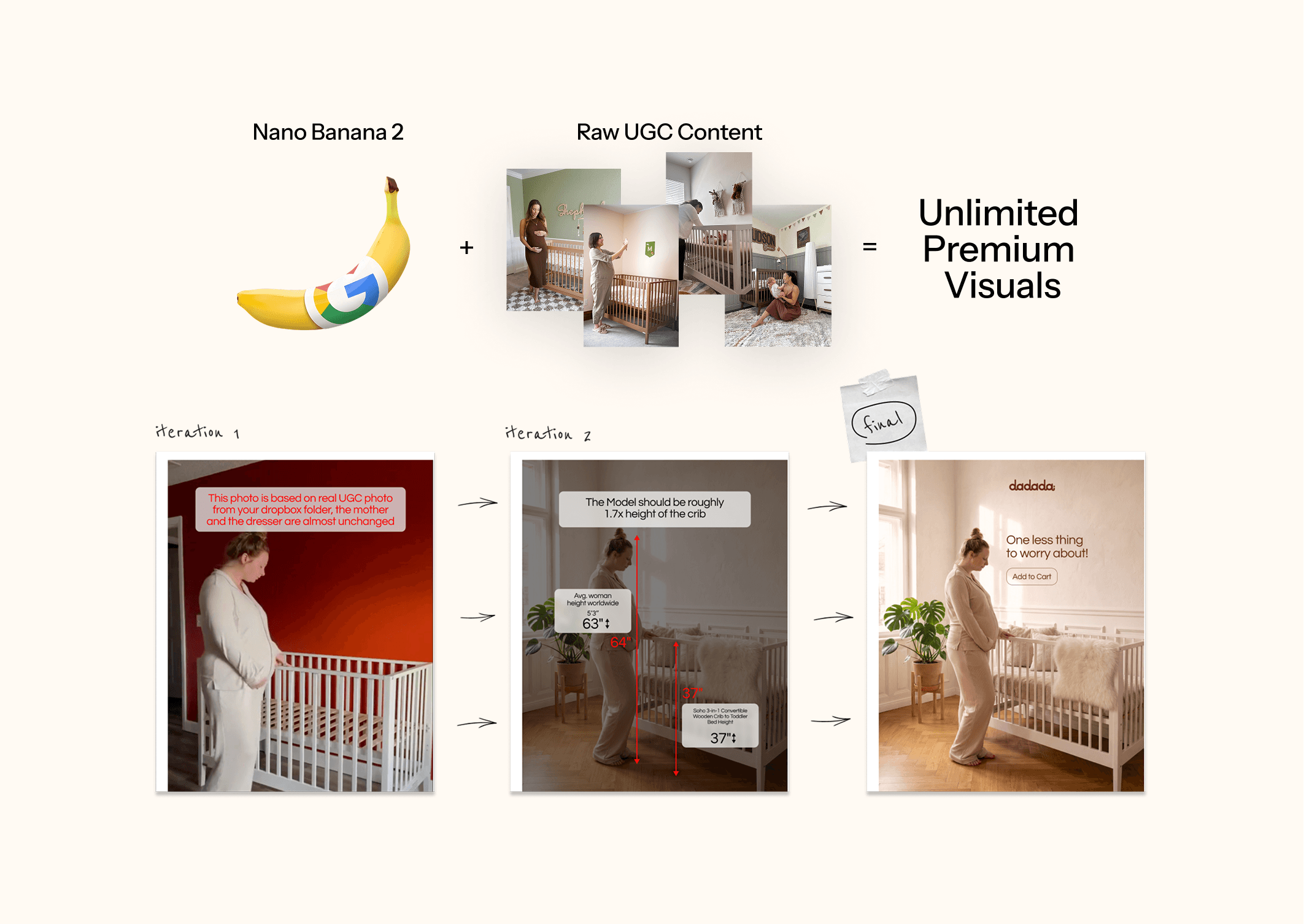
- Accurate proportions — real dimensions, real scale with a person. Parents will be disappointed if the product looks different in their room
- High realism — we used real photos from UGC videos, cleaned them up, refined images. AI-generated visuals built on authentic footage, not fabricated from scratch
- High aesthetics — the ad has to look like it belongs on a design-conscious parent’s Pinterest board
AI Visuals: Under $700 vs $3,000-8,000 Traditional
Traditional product photography for baby furniture requires a staged nursery, photographer, models (often with actual babies), and produces 10-15 usable images for $3,000-8,000.
We used AI image generation to build on existing product photos and UGC footage:
- Nursery scenes with different color palettes, lighting moods, and seasonal themes
- Realistic apartment settings matching the NYC audience’s actual living spaces
- Variations across all 6 sales channels — DTC, Amazon, Target, Babylist, Wayfair, Bambi Baby
- Seasonal refreshes without reshooting
One AI session produces 20-30 visual variations. Total cost: under $700. That is a 4-10x cost reduction with 2-3x more usable output.
The Static Ad System
The creative strategy split into two tracks:
- Video first: UGC content — nursery reveals, assembly process, real rooms. Real parents showing the product in their actual apartments
- Static ads: Clean layouts with reviews integrated naturally, safety callouts in visual hierarchy (JPMA, CPSC, ASTM certifications)
Competitor language pulled directly from Amazon reviews — “solid wood,” “beautiful in person,” “worth every dollar” — went straight into ad copy.
InstaHeadshots — OKAD Creatives at ROAS 2.26
InstaHeadshots is an AI headshot platform. We analyzed their full Meta Ads account: 695 ads, $471,970 spent, 7,648 purchases.
OKAD vs rest of account:
- OKAD average CPA: $63.77 (vs $64.62 account average)
- OKAD average ROAS: 1.39 (vs 1.36 account average)
- 28.6% of OKAD budget in ROAS 1.5+ ads (vs only 12.4% for the rest)
Top OKAD concepts by ROAS:
- StraightToLinkedIn — 16 purchases, CPA $40.87, ROAS 2.26. Specific use case (”→ Straight To LinkedIn”), LinkedIn profile showing the result, “Done in 15 minutes”
- HundredsOfOptions — 18 purchases, CPA $37.82, ROAS 2.15. “One Upload → Hundreds Of Options,” phone with gallery, “Preview Before You Pay”
- RecruiterRankings — 144 purchases, CPA $47.53, ROAS 1.71. Emotional hook (recruiter evaluating your photo), best volume-to-efficiency ratio
Key insight from 695 ads analyzed: Emotional hooks crush rational ones across every metric. Skeptic-to-believer arcs (skeptical → tried it → blown away) convert at CPA $27. Feature-based and pricing-led messaging consistently underperforms.
Creative Framework: What We Learned
Our statics consistently outperformed UGC talking heads on CPA by 11% ($54.45 vs $61.01) while being significantly cheaper to produce.
Across Dadadababy, InstaHeadshots, and ZenToes, the same principles apply:
- Pull creative language from real user reviews — not marketing copy, the words actual customers use
- Lead with a specific use case, not a feature list — “Straight To LinkedIn” beats “AI-powered headshots”
- Produce enough variations to test, not guess — 20-30 AI variations per session, each isolating a single variable
- Match aesthetics to the audience — NYC moms need Pinterest-worthy nurseries, professionals need clean LinkedIn-ready shots
- Authenticity scales with audience expertise — the more expert the audience, the higher the authenticity bar
Frequently Asked Questions
How realistic are AI-generated product visuals compared to traditional photography?
We start with real product photos and UGC footage, then use AI to place products in contextual settings. The result maintains accurate proportions and high realism because the source material is real.
What does an AI visual production session cost compared to a traditional photoshoot?
Under $700 for an AI session producing 20-30 visual variations vs $3,000-8,000 for a traditional shoot producing 10-15 images. That's a 4-10x cost reduction with 2-3x more usable output.
Can AI-generated statics perform at the same ROAS level as traditional creatives?
Yes. Our OKAD creatives for InstaHeadshots achieved ROAS 2.26 (StraightToLinkedIn) and 2.15 (HundredsOfOptions), with 28.6% of budget in ROAS 1.5+ ads vs 12.4% for the rest of the account.
Like this work?
Let's discuss your project — we'll prepare a strategy and estimate within 48 hours.
Book a Call